Every packing list you’ve abandoned had the same flaw: it was written for a hypothetical person going on a hypothetical trip. This one is a system — a fixed core list, a simple outfit formula, and a bag that decides what comes along.
I used to pack for a two-night trip like I was relocating. A full-size suitcase, a duffel for shoes, a tote for “the stuff that didn’t fit.” I’d arrive at a friend’s spare room, open the bags, and use maybe a third of what I’d hauled. The low point was a beach weekend where I brought three pairs of shoes and wore one, and the one I wore was the pair I’d driven down in. Something had to change, and it turned out the fix wasn’t a better list. It was a smaller bag and a different way of thinking about what earns a spot in it.
These days everything for Friday to Sunday fits in a single backpack, including a jacket and a toiletry kit, and packing takes me under twenty minutes. I’ve done this for city weekends, cabin trips, a wedding two states over, and a muddy trail weekend where the gear mattered more than the outfits. The system below is what survived all of those. Steal it whole, or keep the parts that fit how you actually travel.
One thing before the details: this goes beyond minimalism as a hobby. A single bag means no baggage carousel, no checked-bag fee if you’re flying, no leaving things in a rental car you have to walk back to, and, the underrated one, no standing in a hotel room on Sunday night wondering how it all fit on Friday. It just makes the trip easier at every step.
In this article
Start With the Bag, Not the List
Flip the problem around and it gets much easier to solve. Most people write a list and then find a bag big enough for it, and the list grows to fill whatever bag is available, the way a deadline expands to fill the calendar. I do the opposite. I pick the bag first, and the size of the bag becomes the entire budget for the whole weekend, because once the bag is full every remaining decision has already been made for me. No debate, no “what if it gets cold” spiral at eleven the night before.
What size? If you fly even occasionally, a backpack around 30 to 40 liters hits the sweet spot. That’s the range that fits under the seat in front of you on every major North American airline, which means it counts as a personal item rather than a paid carry-on, and that distinction is worth real money on the budget carriers where carry-ons cost extra. The TSA’s What Can I Bring page won’t size your bag for you, but it’s the authoritative answer for what goes inside it, and I check it any time I’m tempted to pack something odd like a camp stove or a bottle of hot sauce. (Yes, I’ve asked about the hot sauce.)
Once the bag is packed, pick it up. Fully loaded, mine comes in around fifteen to eighteen pounds for a standard city weekend, and I can carry that for an hour through a train station without thinking about it. If the bag passes twenty pounds for a two-night trip, something went wrong at the earn-its-spot stage, usually shoes or a laptop that had no business coming. Weighing the bag sounds fussy. It takes ten seconds on a bathroom scale, and it tells you the truth that zipping the bag shut tries to hide.
If you’re driving, you could go bigger. I’d argue you shouldn’t. The discipline of a sub-40-liter bag is the whole system, because it forces every item to pass the same test, which is whether it earns its spot. A bigger bag reopens every question you already settled, and the old overpacking habits creep back in wearing a new hat.
The bag isn’t the container for your list. The bag IS the list. Whatever doesn’t fit was never coming anyway.
The Core List That Never Changes
Most packing anxiety comes from starting at zero every single trip. You stand in front of a closet and interrogate it. Good news: the things you need on a weekend trip barely change. Toothbrush, charger, one set of sleep clothes, the handful of dailies like glasses and medication. That’s the core list, and I keep it written down in a note on my phone, once and for all.
What makes it work is that the core list is finished. It never gets renegotiated. When a trip comes up, I copy it, delete the two or three items that obviously don’t apply (the swimsuit comes off for a mountain weekend, say), and then I only have to think about the variable part: outfits and activity gear. That cuts the actual decision-making from about forty choices down to maybe eight, or ten if the weather looks weird.
| Zone | What’s in it | The rule |
|---|---|---|
| Dailies | Wallet, keys, phone, glasses, medication, charger | Non-negotiable. Lives in the same pocket every trip. |
| Sleep + base layers | Sleep clothes, socks, underwear | One set per night, plus one spare of each. |
| Toiletries | Toothbrush, paste, deodorant, anything you use daily | Everything under 100 ml if you fly; decant once, keep the kit packed. |
| Outfits | Day clothes built from the 1-2-3-4 formula below | The bag decides how many. Optimism doesn’t get a vote. |
| Activity gear | Swimsuit, hiking shoes, wedding outfit, whatever THIS trip needs | Declared before packing starts. One trip, one activity focus. |
You’ll notice the core list has a built-in spare-sock philosophy, which is one extra of the small stuff that fails silently. Not two extras. One. Underwear is the classic example, and a single extra pair weighs almost nothing yet has rescued more weekends than any other item I’ve ever packed, mostly because rain happens and so does falling in a creek.
The 1-2-3-4 Outfit Formula
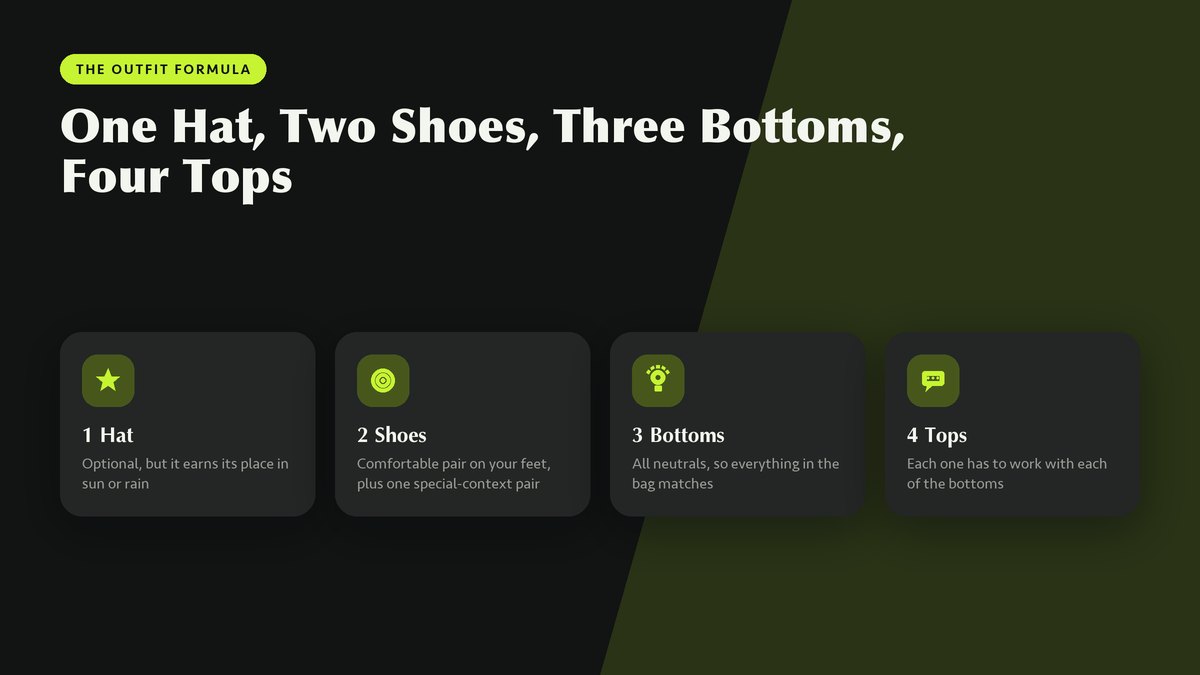
Outfits are where packing lists go to die, so they get a formula instead of judgment calls. I pack one hat, two pairs of shoes, three bottoms, four tops. That’s it. With three bottoms and four tops you can build somewhere around a dozen different-looking combinations, which is more variety than a three-day trip can possibly use, and nobody you’re visiting is keeping score on your wardrobe anyway.
The logic matters more than the numbers. Everything has to mix with everything else, which means no statement pieces and nothing that only works with one specific other item. If a top only goes with one of the three bottoms, it stays home and a more boring top takes its place. Boring is the feature. When everything matches everything, you can get dressed in the dark at a cabin and still look fine at breakfast.
Color does quiet work here too. I default to a base of navy, gray, and off-white, with one brighter top if I feel like it, because that palette forgives almost any combination and hides a coffee splash from day one until day three. Matching outfits on a two-night trip is a solved problem, honestly; the only way to lose is to introduce a pattern that fights everything else in the bag. Which is a long way of saying my weekend wardrobe is intentionally dull, and I consider that a feature, because dull packs small and dull never looks wrong.
The two-pairs-of-shoes rule is the one people push back on, so let me defend it. One pair is worn on the way there, and it’s the comfortable pair you’ll actually walk in. The second pair covers the trip’s one special context. Dress shoes for a wedding, sandals for the beach, boots for the muddy trail. If you can’t name the specific context the second pair serves, you don’t need it, and that includes the “nice pair just in case.” In case of what? A spontaneous yacht party?
The “Earn Its Spot” Test for Everything Else
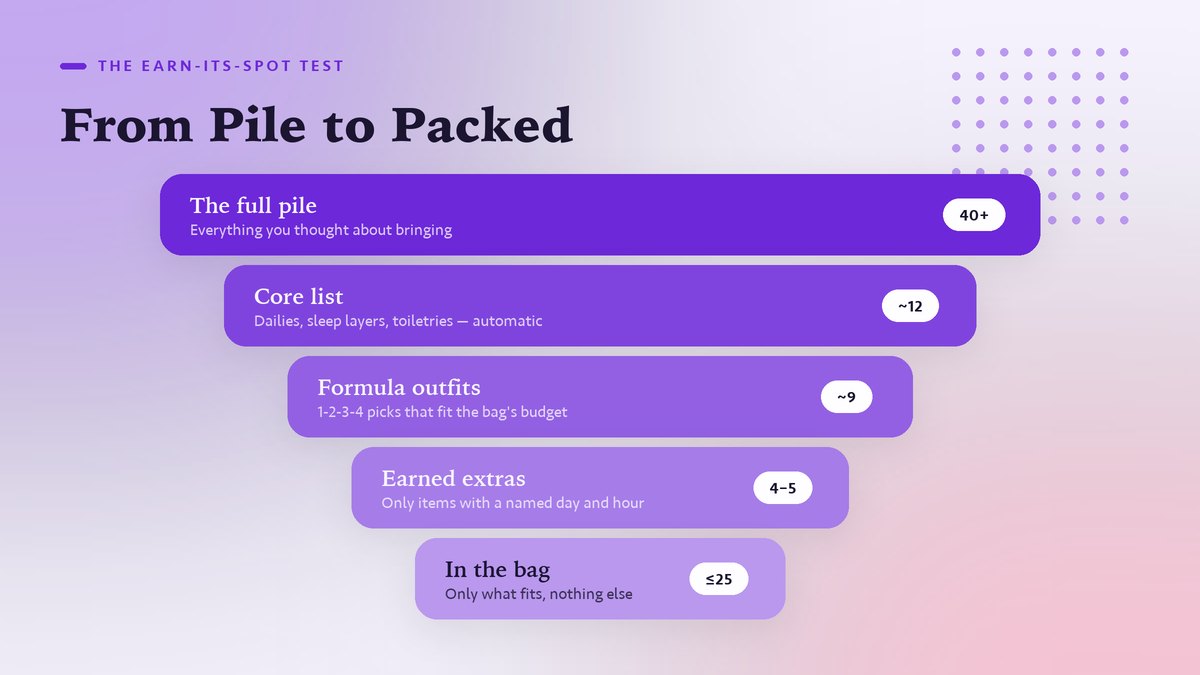
Everything that isn’t on the core list or part of an outfit has to pass one test, and it’s worth saying out loud while you hold the item. Name the exact moment you’ll use it. A day, an hour. “I’ll wear this fleece Saturday morning at the trailhead” passes. “I’ll probably want an extra hoodie” fails, because that sentence has no time in it, and items without a scheduled moment get used almost never.
The test works because it turns packing from a guessing game into a planning exercise. You picture the actual weekend, Friday dinner to Sunday drive home, and each item either has a scene in that movie or it doesn’t. This is roughly how experienced backpackers think, and you can see a formal version of the same idea in the National Park Service’s Ten Essentials, which is framed around systems you’ll actually need outdoors rather than things you might conceivably want. Want is a bottomless category; need has edges.
I do make one deliberate exception, and you should know about it because it’s the loophole that keeps the rest of the system honest. One comfort item is always allowed, no justification required. A real book instead of the e-reader. A fancy coffee setup for the cabin. Whatever your version is. One item. The limit matters more than the choice, because “one comfort item” is a rule you can follow, and “pack what makes you happy” is a rule that fills a suitcase.
Roughly, this is how the filtering shakes out in practice, from “definitely comes” down to “probably stays”:
How to Actually Pack the Bag
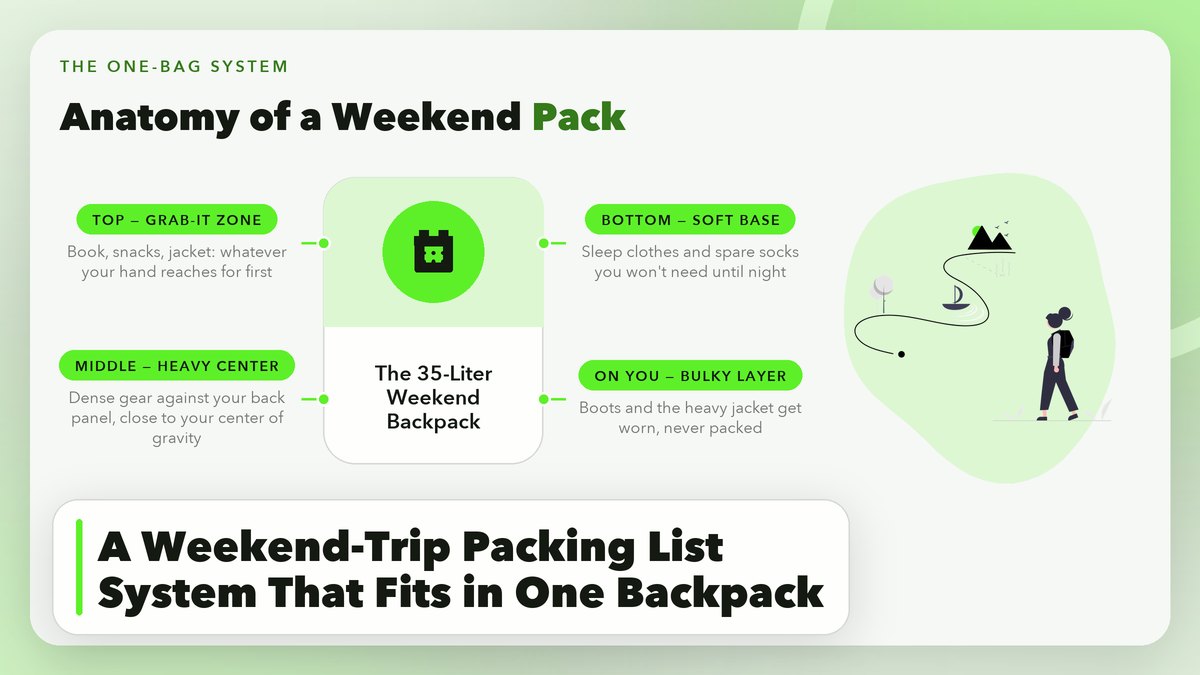
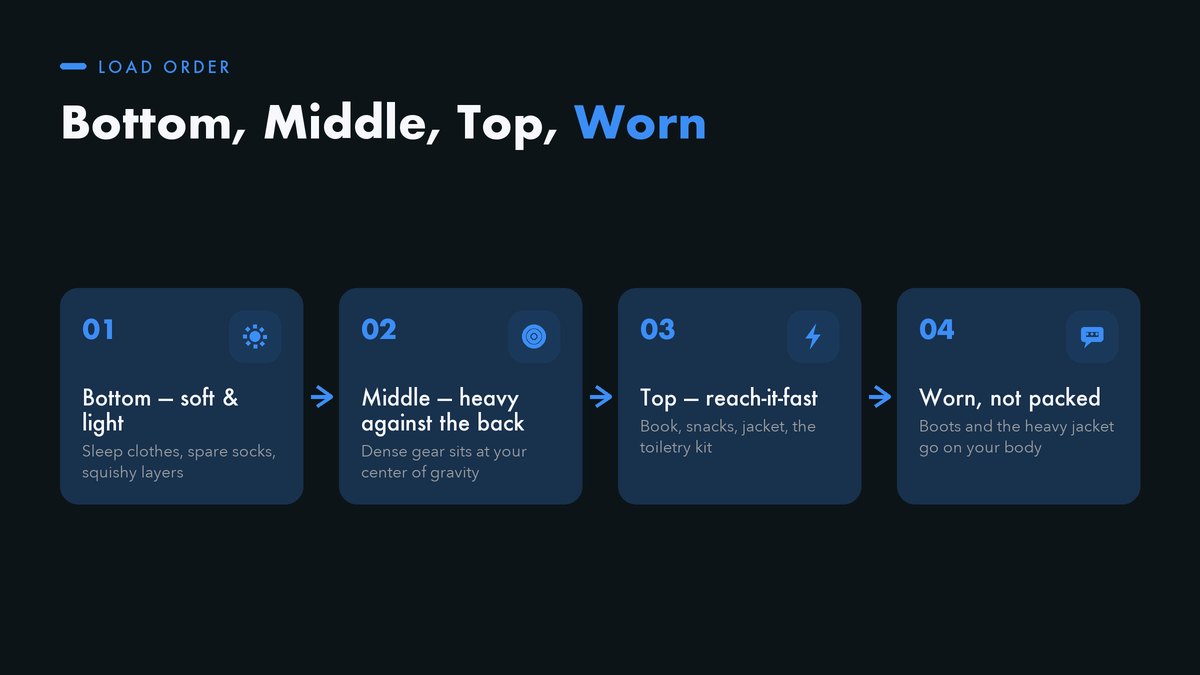
What goes where inside the bag matters more than people expect, and it’s a solved problem. Heavy stuff goes in the middle, against your back, because that’s where the weight sits closest to your center of gravity and stops pulling you backward. Light, squishy things go at the bottom: sleep clothes, that spare pair of socks, the fleece you won’t need until morning. The top layer is reserved for the things you’ll reach for en route or on arrival: the book, the snacks, the jacket, the toiletry kit if you’re arriving late and brushing your teeth before falling into bed.
The middle-heavy principle isn’t folk wisdom. Outdoor educators have taught it for decades, and Deuter’s guide on packing a backpack correctly lays out the same bottom-middle-top logic. For a weekend travel backpack the stakes are obviously lower than on a through-hike, but the comfort difference between heavy things swinging around at the bottom of the pack and weight sitting snug against your back is real, from the first curb to the last stairwell.
A few small packing habits do outsized work, and none of them require buying anything:
- Roll soft things, fold structured ones. T-shirts and underwear roll into tight cylinders that fill gaps. Button-downs and anything that wrinkles get folded once, on top.
- Use one packing cube or a grocery bag. Not a cube system, just one. It’s the “clean clothes” boundary, and on Sunday it becomes the dirty-laundry bag. One bag, two jobs.
- Wear the bulkiest items. Boots, the heavy jacket, the chunky sweater. On your body, not in the bag. This alone frees up a shocking amount of space, maybe a quarter of the whole pack.
The Flying Version: Checkpoint Rules Worth Knowing
If the weekend involves a flight, the bag has to survive security screening, and most packing headaches there are self-inflicted. Liquids over 100 ml (3.4 ounces) get confiscated, full stop, so the permanently packed toiletry kit needs to live in travel sizes. The TSA’s searchable list covers the weird cases (trekking poles, camp fuel, that hot sauce), and it’s worth thirty seconds of your time before any trip where gear is involved.
Batteries are the rule people get wrong most often. Spare lithium-ion batteries, including power banks, must travel in the cabin, never in a checked bag, and terminals should be protected from shorting. The FAA’s PackSafe guidance explains why in plain terms. A battery that fails in the cabin can be seen and dealt with by the crew; one that fails in the cargo hold, out of sight in a confined space, cannot. In a one-bag system this rule barely costs you anything, since the bag comes aboard anyway.
Weather ruins more weekends than any packing mistake, so make the forecast part of the ritual. I check the National Weather Service the morning of departure for both the destination and any trailheads on the plan. One look tells you whether the fleece earns its spot or the rain shell takes its place. Checking three days out is theater, though, because mountain and coastal forecasts that far ahead are basically a coin flip, so check the day you leave instead.
What Always Gets Left Behind
Finally, the confession section, because knowing what to cut is most of the skill. These are the things that used to come on every trip with me and now never do:
- “Just in case” outfits. The nice shirt for a hypothetical nice dinner. If a fancy dinner was actually the plan, it’d be on the itinerary and it’d pass the earn-its-spot test like anything else.
- Full-size toiletries. The hotel has shampoo. You have a permanently packed travel kit. The big bottle stays in the shower where it belongs.
- Duplicate gadgets. Two pairs of headphones, a tablet AND a laptop AND an e-reader. Pick one screen beyond your phone. Maybe two if the trip is built around one of them.
- Work stuff. Unless the weekend is explicitly a workation, the laptop stays home, and I’ve found that “I’ll just quickly check in” almost never is quick, for me anyway. The weekend is shorter than the inbox is long.
- A towel. Every place you’ll realistically stay has towels. This one took me years to accept, partly because a certain sci-fi book made carrying a towel sound wise. It isn’t. I’ve made my peace with it.
And the pattern in all of these is that they were answers to imaginary problems. The system works because it only lets you pack for the trip you’re actually taking (the one with a Friday dinner, a Saturday trailhead, and a Sunday drive home), and imaginary trips, it turns out, have imaginary luggage.
Pack the bag the night before and set it by the door. So you’re free to spend the last workday actually working instead of mentally repacking. You’ll forget something small eventually. Everyone does, and almost everything is replaceable for under twenty dollars within a mile of wherever you’re staying. The jacket you’ll regret is the one you talked yourself out of bringing.
The Twenty-Minute Pack, the Night Before
Timing matters more than it should. Pack the morning of departure and you’ll rush, and rushed packing is how the “just in case” pile sneaks back in, because nobody makes good decisions at 6:40 am with a train to catch. Pack three days early and you’ll reopen the bag twice a night to second-guess yourself, which is its own failure mode. The night before is the sweet spot, and the whole system is designed so that’s enough time.
The actual sequence, once the system is set up, is almost boring. Copy the core list off my phone, strike the two or three items that don’t apply, build outfits from the 1-2-3-4 formula, run the maybes through the earn-its-spot question, load the bag bottom-middle-top, weigh it, zip it, done. Twenty minutes, give or take five. The first time through takes longer, maybe forty-five minutes while you write your own core list and find a travel-size deodorant. By the third trip the whole thing runs on autopilot, and autopilot is the real goal here, not a perfect list but a packing process that no longer requires a decision from you at all.
Related reads on this site: How to Plan a Road Trip Route That Stays Flexible. External sources checked November 2026: TSA (tsa.gov), FAA PackSafe (faa.gov), National Park Service (nps.gov), National Weather Service (weather.gov), and Deuter’s packing advice.