The best road trips I’ve taken had almost nothing booked in advance, and the worst one had every night locked in months early. The middle path is a route with a spine and a lot of wiggle room.
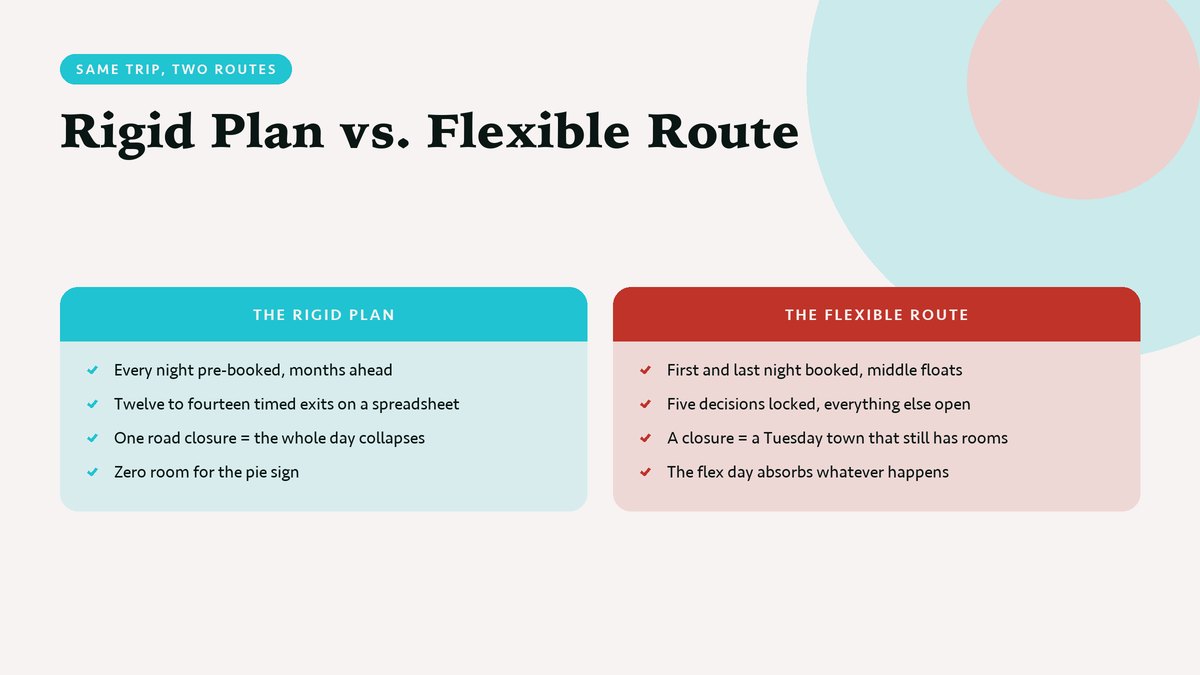
There’s a version of road trip planning that looks great on paper. Hour by hour, four prepaid motel bookings, rest stops timed to the minute on a spreadsheet. Then mile sixty happens. A pass closes, a town festival eats every parking space, or the lake is just too inviting to leave. Rigid plans don’t survive contact with the road, and that’s fine by me. Driving somewhere is supposed to have some give in it.
Swings the other way cause their own trouble. No plan at all means an eleven-hour day three because the interesting stuff sat farther apart than the map suggested, or $230 for the last room in a town nobody meant to sleep in. What works is a route with a firm skeleton and loose joints. A start, an end, a rough line between them, and uncommitted space in the middle. That’s how I plan routes now, after a few trips that taught me the expensive way.
The setup takes about an hour and a half. Two hours if the small-town diner research pulls you in, and it will. What you get is a route you can change at breakfast without breaking anything.
In this article
- Start With a Direction, Not an Itinerary
- Anchor the Ends, Leave the Middle Loose
- The Daily Drive Cap That Keeps Trips Fun
- Build a Skeleton Route in Google Maps
- Research Stops Without Pinning Yourself Down
- Know Your Fuel and Time Budget
- One Flex Day Changes Everything
- When the Plan Breaks Anyway
- A Sample Five-Day Flexible Route
- The Ten-Minute Morning Huddle
Start With a Direction, Not an Itinerary
Before opening any app, decide the one thing you won’t compromise on. Usually it’s the endpoint, “we’re ending at the coast,” or an experience, “three days of hiking somewhere green.” Everything else can move. Write that sentence down, even though it looks too simple to matter, because every later decision gets measured against it and decisions get fast.
Then draw a loose corridor on a map, a couple hundred miles wide, between home and that anchor. Inside the corridor almost anything goes. Outside it you’re forcing things, and I’ve cut whole detours for exactly that reason. Backtracking is the quiet budget-killer of road trips. It costs driving time twice and shows you scenery you’ve already seen, which is to say it pays you nothing the second time.
A route is a corridor, not a rail line. One of them forgives a washed-out bridge.
Give yourself a day or two of slack by simply not scheduling the final weekend. If a hot spring keeps you an extra morning, the slack absorbs it. If not, you land at home with a quiet weekend for laundry before work starts again. Both outcomes are fine, which is exactly why the slack works.
Anchor the Ends, Leave the Middle Loose
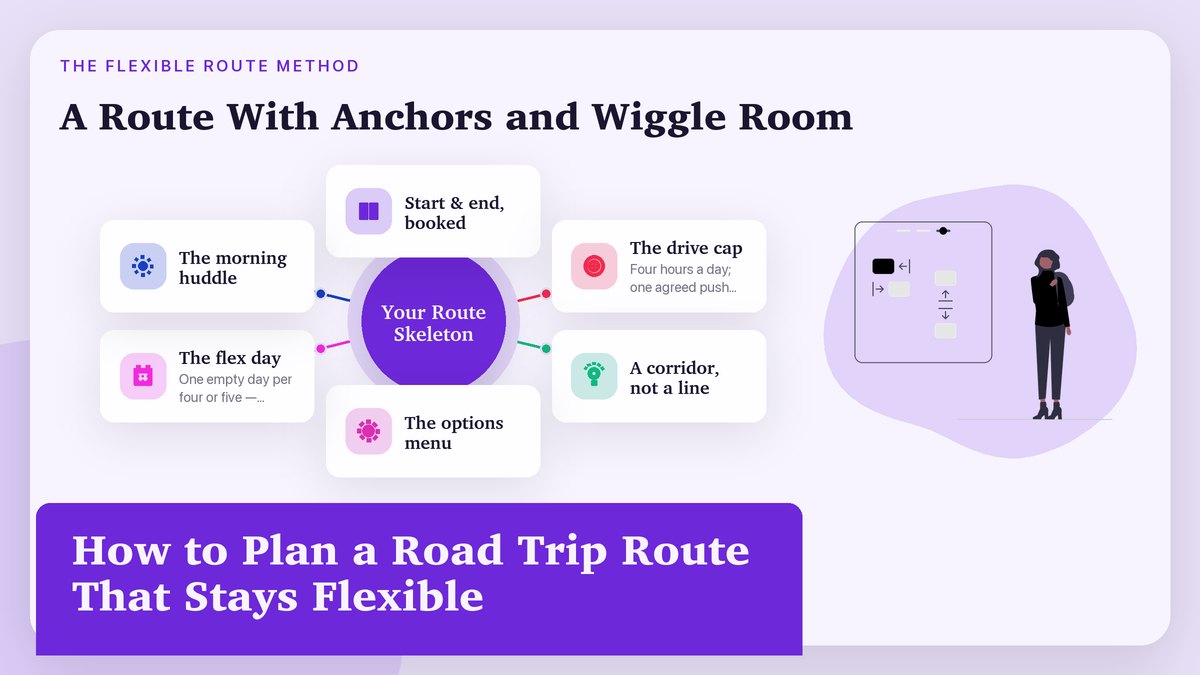
Book the first night and the last night. Nothing else. The first booking is insurance against pulling into town tired and finding the one motel full because of a fishing tournament you couldn’t have known about. The last booking is different in kind. A guaranteed bed on the final stretch takes a real weight off the drive home, and you feel it by hour two.
Everything in between stays open until the morning you need it. People who plan the spreadsheet way find this reckless, but mid-trip booking works better than you’d expect across most of the US and Canada, outside national-park peak weekends and holiday festivals. A Tuesday room in a small city is almost always findable by four in the afternoon, often cheaper than the advance rate, because unsold rooms get discounted same-day. Usually, anyway. (Some careful comparisons would call it a wash on price; my own trips have come out ahead on the weeks I stayed flexible, give or take a holiday town or two.)
Where the open-middle rule really fails is anywhere with a hard capacity limit. Park lodges in July, popular campgrounds, tiny resort towns on a holiday weekend. For those nights, book early. The National Park Service’s trip planning pages are blunt about how far ahead in-park lodging sells out, and they’re right. So the rule refines itself over time. Book any night where the alternative is sleeping in the car, and leave the rest loose.
The Daily Drive Cap That Keeps Trips Fun
Route mistakes rarely happen at the stops. They happen in the distance between them, because map apps shrink everything. Four hours on a screen is four hours of beautiful nothing, plus fuel stops, plus the burger that ran long, plus the antique mall nobody will admit wanting to see.
My cap is four hours of actual driving a day, with one push day allowed per week of trip. The push day is for repositioning between regions, and everyone in the car agrees to it in advance, which matters more than it sounds. A known long day is fine. A surprise long day breeds mutiny by the second fuel stop.
| Daily drive | What it feels like | Best used for |
|---|---|---|
| Under 2 hours | Lazy. Two stops easily fit before lunch | Exploration days around a base town |
| 2–4 hours | The sweet spot. You arrive with energy to do things | Most days of a flexible route |
| 4–6 hours | Tiring. Plan only one activity after arrival | Repositioning between regions |
| 6+ hours | A travel day, full stop. Start early | Once per trip at most; start early |
Fair warning, the cap depends on who’s in the car. Solo drivers fatigue faster. Kids have a hard ceiling that has nothing to do with miles. And two-lane mountain or coastal roads take roughly half again as long as the highway option, which the mileage math never shows you. If your route leans on winding secondary roads, treat the time estimates as optimistic and shave an hour off the daily cap.
Build a Skeleton Route in Google Maps
With the corridor and the cap set, build the skeleton. In Google Maps you can drop up to nine stops into a single route, which is more than enough for this. You’re not mapping every gas station, just the load-bearing stops. I pin three to five things: the anchor destination, one or two would-love-to stops, and a rough midpoint to hunt for rooms around.
Then check the route against your cap by driving time instead of miles, and set the departure time to when you’ll actually leave. One road says 3 h 40 min on a Tuesday morning and something closer to five hours at Friday four in the afternoon, and that gap is the difference between a pleasant evening and pulling in after everything’s closed. For any metro-area stretch on the way home, I add a full hour of buffer without thinking about it.
Save the whole skeleton offline before you go. Offline maps matter more than people expect. Canyon country, mountain passes, and long rural stretches in Canada regularly have zero signal, and a route that lives only in the cloud quits on you at the exact wrong moment. Download the corridor at home on real Wi-Fi while you still remember.
Map apps tell you the fastest way. You still have to pick the nicest way. They’re rarely the same road.
Research Stops Without Pinning Yourself Down
A flexible route still needs a menu of options, and building the menu is the fun part of planning. Collect options instead of commitments. A waterfall an hour off-route is an option. Writing it into day three as a must-see turns it into an obligation, and obligations make a flexible route feel exactly like the rigid one you were trying to escape.
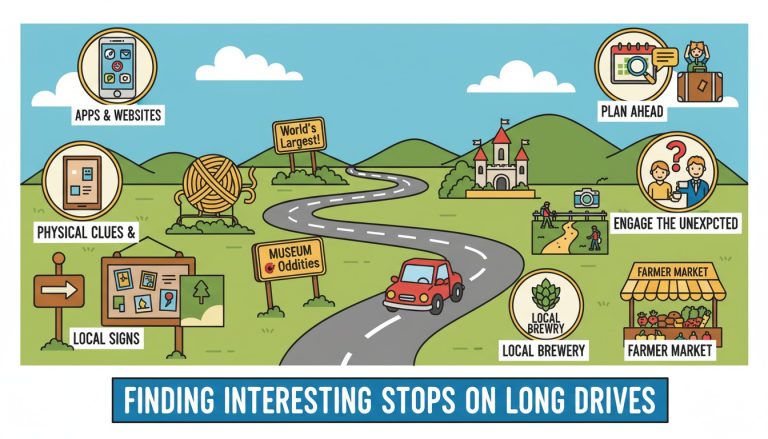
For the menu itself, Roadtrippers is the tool I’d reach for first, because it’s built for exactly this job. Set a corridor and it surfaces the oddball stuff along it, the giant roadside statue, the overlook, the small museum nobody planned on. Cross-check anything promising against recent reviews, since roadside attractions close more often than their websites let on. One dead link across three states is a shrug. Three in one afternoon is a pattern, and the pattern means call ahead or move on.
Keep the list short. Six to ten items for a week, maybe. Forty maybes is procrastination in list form, and nobody reads forty options at a gas station; they freeze over the phone. I’d rather carry seven good options and pick two.
Know Your Fuel and Time Budget
Flexibility costs money if you don’t budget for it, and two numbers are worth nailing down before you leave: fuel and a nightly lodging ceiling. For fuel, the US Department of Energy’s trip calculator beats napkin math by a mile, because it adjusts for your actual car on your actual route, and mountain grades, roof boxes, and 75-mph interstates all drag real-world mileage below the sticker number. I add about fifteen percent to whatever it estimates and I’ve never come up short. (Side note, the same calculator will judge your daily commute if you let it.)
The lodging ceiling does two jobs at once. Set it around $130 a night in most of the US, more in Canada, and considerably more near famous parks in July. It keeps the flexible middle from getting expensive, and it makes same-day booking decisions fast. Six options under the ceiling means you stop scrolling and pick one. Four minutes, done, back on the road.
Food is where the budget surprises people. Restaurant meals three times a day for a week total up to a number that shocks first-timers, and one cooler meal a day knocks roughly a third off it. Buy groceries before leaving home, at your normal store, because the tourist-town store knows exactly what it’s doing with those prices and it is not on your side.
One Flex Day Changes Everything
If you take one idea from this article, make it this one. For every four or five days of trip, leave one completely unplanned. Not lightly planned. Empty. No destination, no reservation, no menu of options. Wake up where you are and decide at breakfast. Call it the flex day, and guard it from your own urge to fill it while planning, because the urge will absolutely come.
The flex day is where road trips earn their reputation. It’s staying two nights in the town that was supposed to be a stopover, or six hours at a lake because the weather turned perfect, or following a hand-painted sign to pie forty minutes off-route and talking to the owner for an hour. None of that fits a scheduled itinerary, all of it is what you actually remember a year later. My flex days have been the highlights of whole trips, and I have never once regretted the empty square on the plan.
It works because of everything else in this article. Un-booked middles, the drive cap, a researched menu. They all converge on the ability to say “we’re staying” at nine in the morning with zero fallout. Honestly, if your route keeps nothing else from this article, a flex day alone puts you ahead of most road trippers.
When the Plan Breaks Anyway
Even the loosest plan meets reality. Storms close passes, wildfire smoke grays out a scenic drive, a breakdown eats a day in a garage bay. The flexible route absorbs these hits far better than a rigid one, but only if the first hour of the problem goes well.
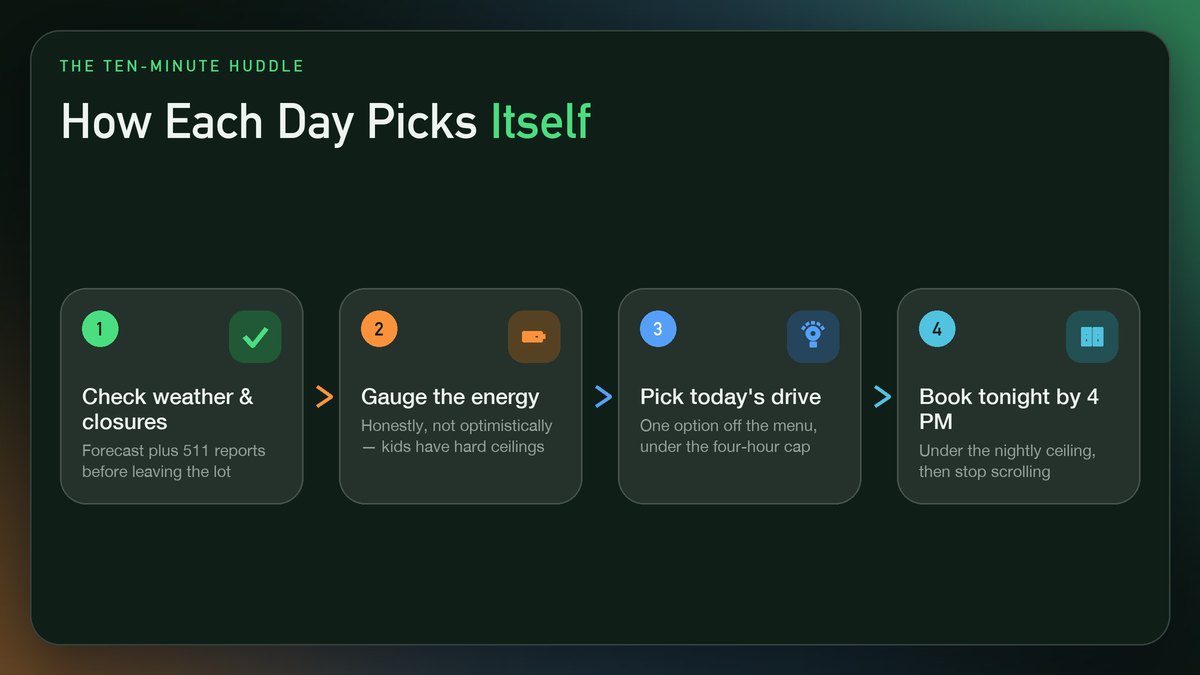
The habit that saves trips is checking weather and road conditions every morning before leaving the parking lot. The National Weather Service site is the reliable US source for forecasts and hazard warnings, and most states and Canadian provinces run 511 road-condition services that report closures and chain requirements in real time. Ten minutes of checking beats two hours sitting at a closure barricade, and it often reveals the trouble sits twenty miles ahead, close enough to detour around and far enough that you’d have hit it at noon otherwise.
When something does go wrong, run the corridor rule in reverse. Ask which direction keeps you inside your corridor, and take it. Closed pass to the south? The town you passed yesterday is still there, still has rooms on a Tuesday, and becomes an unplanned rest day rather than a disaster. The skeleton bends. It doesn’t snap, because nothing in the middle was load-bearing.
Breakdowns end more trips than weather does, so a quick word on those. Get the tires (including the spare, which everyone forgets), battery, oil, and coolant checked about a week before a long trip. It runs maybe fifty bucks at a quick-lube place and it’s the cheapest insurance on this entire list. Then keep a paper fallback for navigation, because a dead phone shouldn’t strand anyone. The eight-dollar state highway map in the glove box has rescued more trips than any app feature I know of.
A Sample Five-Day Flexible Route
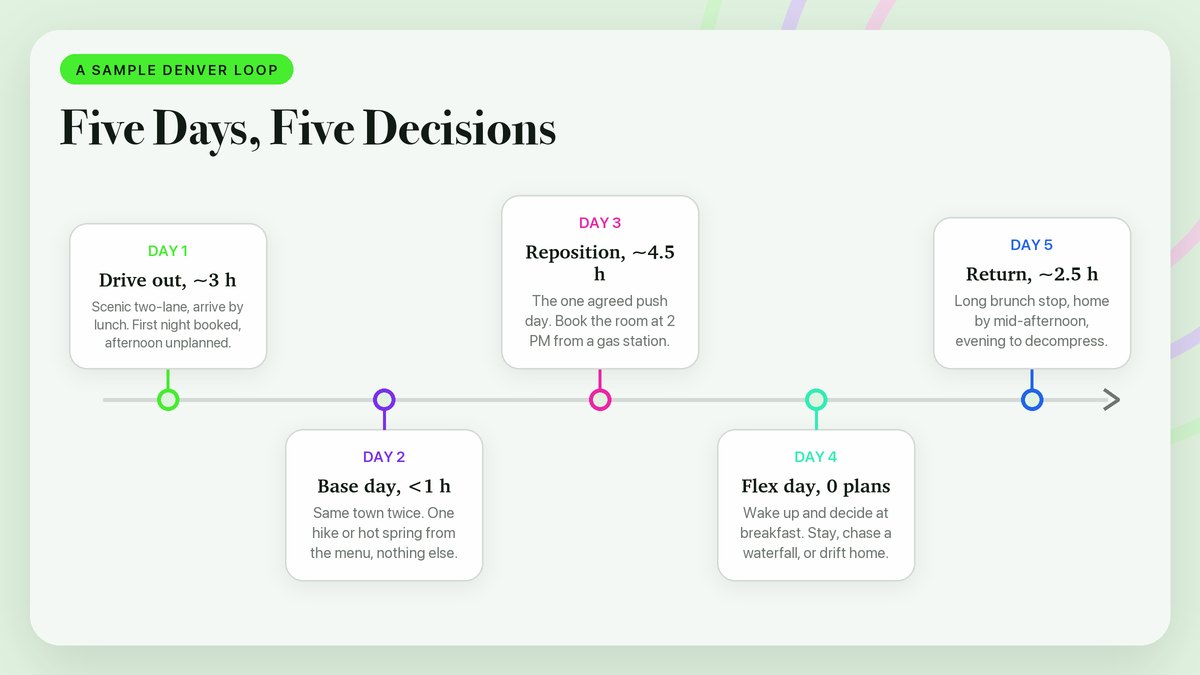
The whole system, assembled on a classic example, a loop from Denver out through the Colorado mountains. Five pinned items in the skeleton. Everything else floats.
- Drive out on day 1, about 3 h. Leave Denver by 8 AM, take the scenic two-lane instead of the interstate, and arrive in the first mountain town by lunch. First night is booked. The afternoon is unplanned, so walk the main street and see what the town offers on its own.
- Base day on day 2, under 1 h of driving. Sleep in the same town twice. One big hike or hot spring from the options menu, nothing else on the list. This is the day a rigid itinerary would have ruined by checking out at 10 AM.
- Reposition on day 3, roughly 4.5 h. The one agreed push day. Cross to the other side of the range on the fastest reasonable route, stop once at the single must-see overlook, and book the room around 2 PM from a gas station with good signal.
- Flex day on day 4, zero commitments. Wake up and decide. Stay a second night, chase a waterfall, or drift toward home a day early if everyone’s tired. The last-night booking near Denver doesn’t care either way.
- Return on day 5, about 2.5 h. Short morning drive home with a long brunch stop somewhere. Home by mid-afternoon with a whole evening to decompress before work.
Count the commitments in that plan. Two booked nights out of four, one agreed long drive, one pinned activity. That’s a full, memorable five-day trip resting on five locked-in decisions. The spreadsheet version of the same trip runs twelve or fourteen bookings with timed exits and no room for the pie sign. Same miles covered. Nothing alike in how they feel.
You don’t remember the miles. You remember the unplanned pie place.
The Ten-Minute Morning Huddle
This system runs on one small daily ritual, and it’s the least glamorous part of this article. Before leaving wherever you slept, take ten minutes over coffee, everyone present, and run three questions. What is the weather doing where we’re headed? How is everyone’s energy, honestly, not optimistically? And which drive from the options menu fits those two answers?
That’s the whole thing.
Book tonight’s room by mid-afternoon, four PM is my cutoff, keep the drive under the cap, and let the flex day absorb whatever the questions surface. The huddle is what turns a loose pile of ideas into a working route, and it takes less time than the motel’s continental breakfast line.
One honest caveat. This style of trip asks a little more of the planner, because you’re making real decisions every day instead of executing decisions made months ago, and some people find that tiring by day six. If that sounds like you, split the difference and pre-book every other night, leaving the rest loose. Half the flexibility still buys most of the benefit. The point was never to reject planning. It’s to plan the things that matter, the ends, the cap, the one or two must-sees, and refuse to plan the things that don’t, like which exact motel or whether the waterfall happens before lunch.
Because the road, in the end, will have opinions about your trip. A flexible route is just a way of agreeing with them early.
Related reads on this site: How to Plan a Road Trip Without Over-Scheduling Every Day and How to Find Interesting Stops on Long Drives (Beyond Gas Stations). External sources are linked inline above; all links checked before publication.