Keychain, wallet, phone, glasses. If you spend even ten minutes a day hunting for
them, the problem isn’t a bad memory. It’s a house where nothing officially lives anywhere,
so everything camps wherever it landed. This is the fix.
Say it’s a Tuesday morning and you’re already seven minutes behind. You pat
your pockets. Keychain: no. Yesterday’s jacket: no. Kitchen counter, couch cushions, the
floor of the car. You find it at last in the bathroom, next to the toothpaste, for reasons
nobody will ever explain. Multiply that little scavenger hunt by a few objects and a few
rooms, and a normal week loses an hour or more to looking for stuff you already own.
That’s the strange part. The keychain was in your hand last night. Your brain worked
fine; the system around it didn’t.
This article is about that system. Not a bigger house, not a shopping trip to the
basket aisle, and definitely not a personality transplant where you wake up one day as a
tidy person. A home-for-everything system is smaller than all that. You decide once where
a handful of everyday objects live, you build a two-minute habit around putting them
back, and then the whole problem mostly evaporates on its own. I’d argue it’s the
highest-return organizing project there is, because the objects it covers are the exact
ones that make you late.
In this article
- Why your brain keeps losing things
- The one rule: everything gets a home
- Group by where you use things, not what they are
- Give your drop zones a promotion
- The two-minute nightly reset
- A home for the stuff that has no home yet
- When you live with other humans
- The two-week shakedown
- Start with three objects tonight
Why your brain keeps losing things
Start with the hardware, because the hardware explains most of it. Working memory,
the mental scratch pad that holds “my keychain is on the hook,” is tiny. The
APA dictionary entry spells out
what that means: a limited-capacity store that holds a few pieces of information for a
few seconds, and anything that doesn’t get rehearsed or written down fades fast. You can
remember where you set something down, but only if you were actually paying attention at
the exact moment you set it down. Most of the time you weren’t. You were carrying
groceries, thinking about email, talking to someone. The object got put down by a brain
that was busy with something else, which is the same as saying it got put down at random.
There’s a sneakier layer underneath. Every time an object moves to a new temporary
spot, it overwrites the last place you remembered it. Researchers call this location
updating, and it shows up in studies with as few as a handful of locations. Your house,
meanwhile, offers dozens of plausible flat surfaces. Each one your keychain touches makes
the previous location harder to retrieve, so by the third couch cushion you aren’t
searching anymore. You’re re-encoding, laying down fresh memories of places the thing
isn’t.
None of this means you’re doomed or scatterbrained. It means the job got assigned to
the wrong department. Stop asking your brain to track thirty objects across thirty
surfaces and give it one rule instead: everything has a home, and the home doesn’t move.
Put the remembering into the room itself.
Fewer places where things can be. That’s the whole fix.
The one rule: everything gets a home
The whole system rests on a single decision, made once per object. Where does this
live? Where it lives, permanently, the way the toothpaste lives in the medicine cabinet,
as opposed to wherever you happened to see it last. As soon as an object has a designated
spot, finding it stops being a memory task and turns into a lookup. You don’t recall
where the scissors are; you walk to the spot. It works when you’re tired. It works when
you’re carrying a laundry basket and thinking about a deadline.
James Clear has written about this better than most, and his piece on
environment design gets at the
same idea from the habits angle: you don’t rise to the level of your intentions, you fall
to the level of your surroundings. A hook by the door beats a resolution every single
time, because the hook is still on duty at 6:40 in the morning, long after the resolution
has checked out.
A few rules for picking homes, since a bad home is worse than none. The home has to be
reachable from where the object gets used, or at least from where you are when you last
touch it. Your keychain hangs at the door you actually exit through, not the decorative
front door nobody uses. The phone charger lives where the phone sleeps. And the home has
to be easy to hit, a hook you can spear one-handed without looking or a bowl you can drop
things into from a foot away. If putting something away takes two hands, precision, or
moving three other things first, that’s a storage assignment, and you’ll skip it by
Thursday.
Also, give up on the fantasy of exactly one home per object. Sometimes the right
answer is two homes, one at the door and one on the nightstand, as long as the rules are
crisp about which home is active when. My honest take: two clear homes beat one fuzzy
one. A fuzzy rule (“usually the hook”) is just a slow-motion way of losing the same
things over and over.
Group by where you use things, not what they are
Next comes organizing the homes themselves, and this is where most people go
sideways. They sort by category, librarian style: all the pens together, all the tape
together, all the little tools in one heroic toolbox. It looks beautiful in photos. It
works terribly in a house, because you don’t live by category. You live by room and by
activity, and the scissors you actually need are the ones near the kitchen counter, not
the fifth identical pair sitting in a drawer across the apartment.
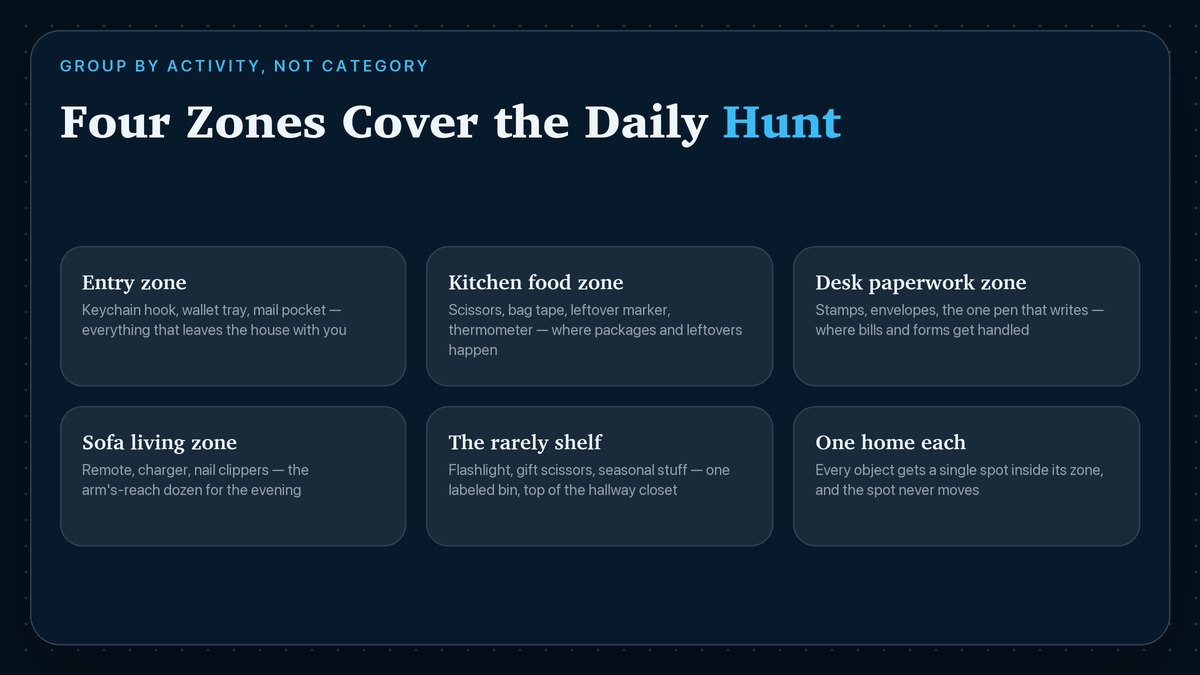
So sort by activity zone. The kitchen gets a food zone: scissors, tape for bags, the
decent thermometer, a marker for labeling leftovers. Your desk gets a paperwork zone
with stamps, envelopes, and the one pen that still writes. The sofa gets a small living zone: the remote, the charger you always want, nail clippers if that’s your life. Each
zone holds the dozen or so objects that belong to whatever happens there, every object
with its own home inside the zone, and duplication is fine. Two pairs of scissors you can
always find beat one pair that’s theoretically somewhere.
Notice what’s missing from this approach: any sorting of the things you use once a
month. Seasonal stuff, the good scissors for wrapping presents, the flashlight that
matters during exactly one power outage a year. Those share a single rarely zone, one shelf or bin, clearly labeled. Which is really just a formal way of admitting that the attic, the junk drawer, and the back of the closet were always the same storage philosophy wearing different costumes. A monthly object doesn’t earn prime real estate, though
it does earn an address. When the power goes out, “the rarely bin, top shelf of the
hallway closet” is a perfectly good answer.
Give your drop zones a promotion
Now the part nobody wants to hear. You will keep dropping things by the door, on the
kitchen counter, on the arm of the sofa. Not sometimes. Daily. Behavior follows the path
of least resistance, and the path of least resistance in any home ends at whatever
surface sits closest to your hand when you walk in. Fighting that is a losing battle.
Hire the drop zones instead.
A drop zone is anywhere objects naturally pile up, and the move is to promote it from
a surface into a system. The counter by the door gets a small tray for your keychain,
wallet, and mail, set exactly where your hand wants to drop them. The kitchen counter
earns a single bowl for sunglasses and the dog leash. Each one is a concession to
gravity, with edges, so the pile can’t migrate three feet in every direction overnight.
There’s a hard limit, though. Every drop zone needs a scheduled evacuation, or it
stops being a landing pad and turns into a junk drawer with better lighting. My rule
pairs the nightly reset, coming up, with one weekly cull where the mail tray actually
gets emptied. Keep the count of drop zones small. Two or three. Each one you add is
another mouth to feed.
with good intentions. Put a physical container (a bowl, a shallow box, even a dinner plate you already own) under every drop zone you allow. The edges do the discipline;
you don’t have to.
The two-minute nightly reset
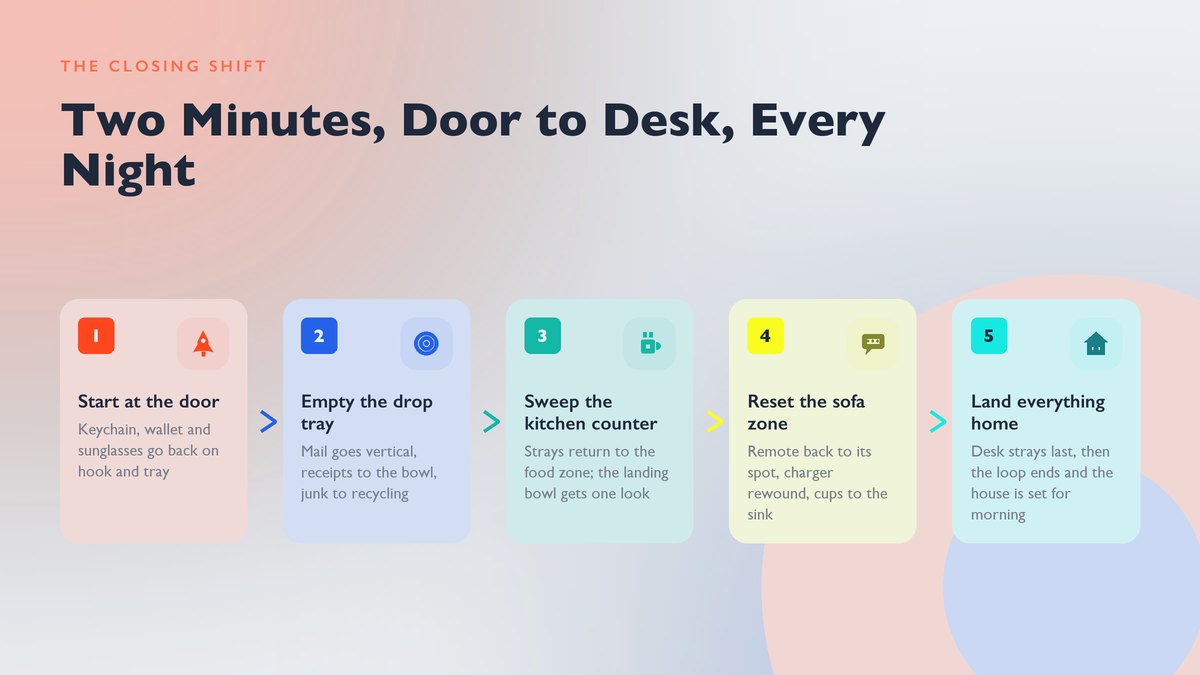
Habits hold systems together, and this one runs on exactly one habit: the nightly
reset. Two minutes, timed, right before bed or right after dinner. You walk the same short loop every night (door, kitchen counter, sofa, desk) and return every stray
object to its home. It’s the closing shift of the whole operation, and it works because
it hangs on a trigger you already have, like loading the dishwasher, instead of
willpower you don’t.
The reset does three jobs at once. It rescues the drop zones, which we know will fill
up. It catches the drifters: the tape measure abandoned on the kitchen table after a
heroic attempt to hang a picture, the book that migrated to the bathroom. And it means
you start every morning in a house where the ten things you need are all in their homes,
which is the real payoff here. Nobody hunts for anything in a house where everything got
put back last night.
Be honest about timing. Two minutes is right for a one-bedroom or a small house, once
the setup work is done. Bigger place, or a brand-new system with half your objects still
homeless, and the first resets run closer to ten. That’s fine. I said two minutes
earlier; some weeks it’s five. The streak matters more than the stopwatch, and after
about two weeks the average drops fast anyway, since there’s simply less loose stuff
left to rescue each night.
A home for the stuff that has no home yet
Somewhere in the middle of this project you’ll hit the awkward pile. Chargers for
mystery devices, takeout menus from a restaurant that closed, three allen wrenches of
unknowable origin. These objects are homeless because you truly can’t tell what they are
or whether they’ve earned a spot, and forcing a decision on each one tonight is exactly
how the whole project stalls out.
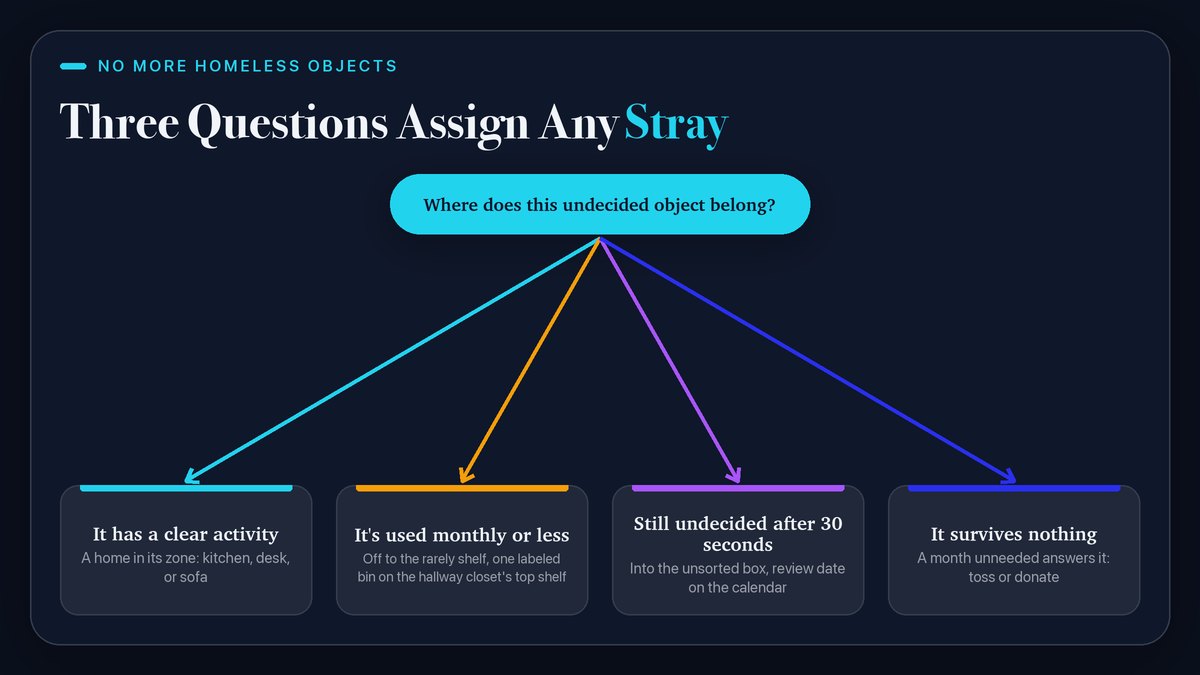
So give the undecided their own home. One box, a shoebox is perfect, labeled
“unsorted,” parked in the closet. Anything that can’t get a home within thirty seconds
of thought goes in the box, no deliberation allowed. (I’ve never once regretted the
shoebox, for what that’s worth.) Then give the box a review date, one month out, on the
calendar. When the date arrives you spend about fifteen minutes with it, maybe less, and
most of what’s inside gets tossed or donated. A month of not needing something is the
answer to whether you need it. Whatever survives earns a real home, which by then takes
about ten seconds to assign.
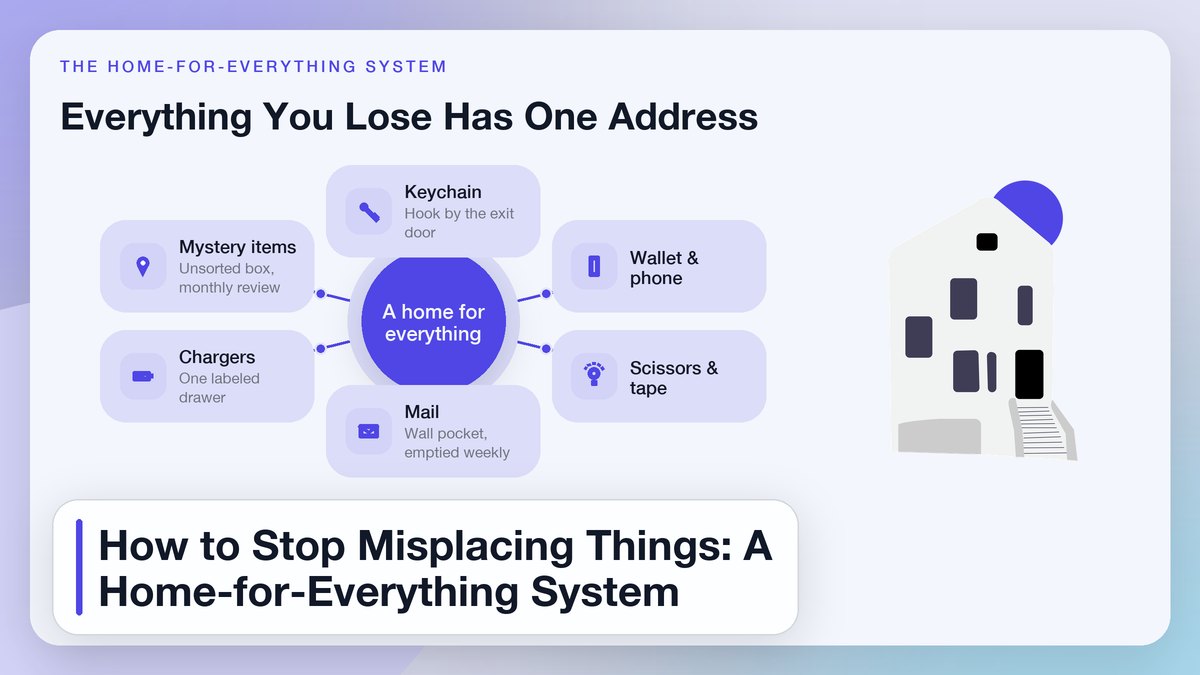
| Object | Its home | Why it works |
|---|---|---|
| Keychain | Hook by the door you actually exit through | You can hit it without looking, and it sits on the path out |
| Wallet & phone | Small tray in the entry zone | One-handed drop, visible from the door, can’t roll away |
| Wall pocket or letter tray, reviewed weekly | Vertical, so it can’t snow sideways across the counter | |
| Chargers | Labeled pouch or one drawer, cables coiled | One address beats four “somewhere in the desk” locations |
| Scissors & tape | Food zone cup or hook, kitchen-side | Lives where the packages actually get opened |
| Mystery items | The “unsorted” box, monthly review | Decisions deferred, but not lost |
When you live with other humans
A system you maintain alone is a hobby. If anyone else walks through your door, whether that’s a partner, kids, or a roommate with opinions about coasters, the homes have to be shared, or
they’ll get quietly un-invented within a month. The good news: other people aren’t the
problem people assume. Most household friction over lost things isn’t about memory at
all. It’s that no spot was ever agreed on, so everyone runs a private system, and those
systems collide on the same three surfaces.
The fix is boring and fast. A ten-minute household meeting, one time, walking room to
room: “the keychain lives here, mail lives here, the good scissors live here, and if you
move them, the new spot is the rule.” Write the big ones on a sticky note inside the
cabinet door for the first month. Kids handle this far better than adults expect,
especially with a low hook they can actually reach. The same logic, a clear agreed spot for each thing, is why storage makers like
The Container Store
sell thousands of near-identical hooks and trays. The hardware hardly matters. The
address does.
Also, lower your standards on purpose. In a shared home the goal isn’t perfection;
it’s a house where the eight objects everyone needs are findable by everyone. The junk
drawer stays. The winter bin stays messy. I’d rather have a household that can reliably
find the keychain, the tape, and the checkbook than one with a color-coded pantry and a
cold war over the dishwasher. Fight for the essentials.
Concede the rest, because a household where everyone can reliably find the eight everyday things that matter has already won the only game in this article that’s actually worth playing.
enters the house, a gadget, a gift, a tool, assign it a home the day it arrives, even
if the home is “the unsorted box.” New items without a home are tomorrow’s missing
items.
The two-week shakedown
Expect the system to feel slightly fake for about two weeks. You’ll hang the keychain
on its new hook and then find it in your jacket pocket anyway, because the old habit has
a few hundred repetitions behind it and the new one has four. This is normal, and it’s
the stage where most people decide the system doesn’t work and quit. The system works.
It’s just outnumbered.
What carries you through is a small streak, not a big commitment. Put an X on the
calendar for every night you ran the reset, and give yourself one free pass a week for
the night you collapse on the sofa instead. Somewhere around day ten it starts feeling
strange in the good direction: you walk past the hook, notice the keychain in your hand,
and hanging it up feels like the default rather than a chore. By week three the hunts
just stop happening. Which is the point.
If you want a more ritualized version of the same arc, small daily routines adding up to a house that stays handled, the FlyLady
method has run a version of this loop for two decades, built on short timed resets
rather than marathon cleaning sessions. And the decluttering half of the project,
deciding what earns a home at all, pairs naturally with the
KonMari method, which starts from whether an item
matters rather than whether there’s room for it.
Start with three objects tonight
Don’t reorganize the whole house this weekend. You won’t finish, and the half-done
version is worse than none, because now there are boxes everywhere and the scissors are
inside one of them. Instead, tonight, pick the three objects you lose most. For almost
everyone that’s the keychain, a phone or wallet, and one personal wildcard like glasses
or a hair tie. Give each one a home. Put the hook up. Set the bowl out.
That’s the entire assignment. Then run the two-minute reset before bed, and again
tomorrow. Within a week, finding those three things stops being an event. Add a zone a week after that (the kitchen counter, the desk, the sofa) and in about a month the
whole house is covered without a single dramatic Saturday spent knee-deep in bins. Slow
is fine here, the keychain has nowhere else to be. It just needs a hook that’s always in
the same place.
Updated November 2026. Related reads on this site:
Digital Declutter: Organizing Your Phone in Under an Hour,
The 2-Minute Rule, and
Small Space Organization Ideas.
External sources checked November 2026.