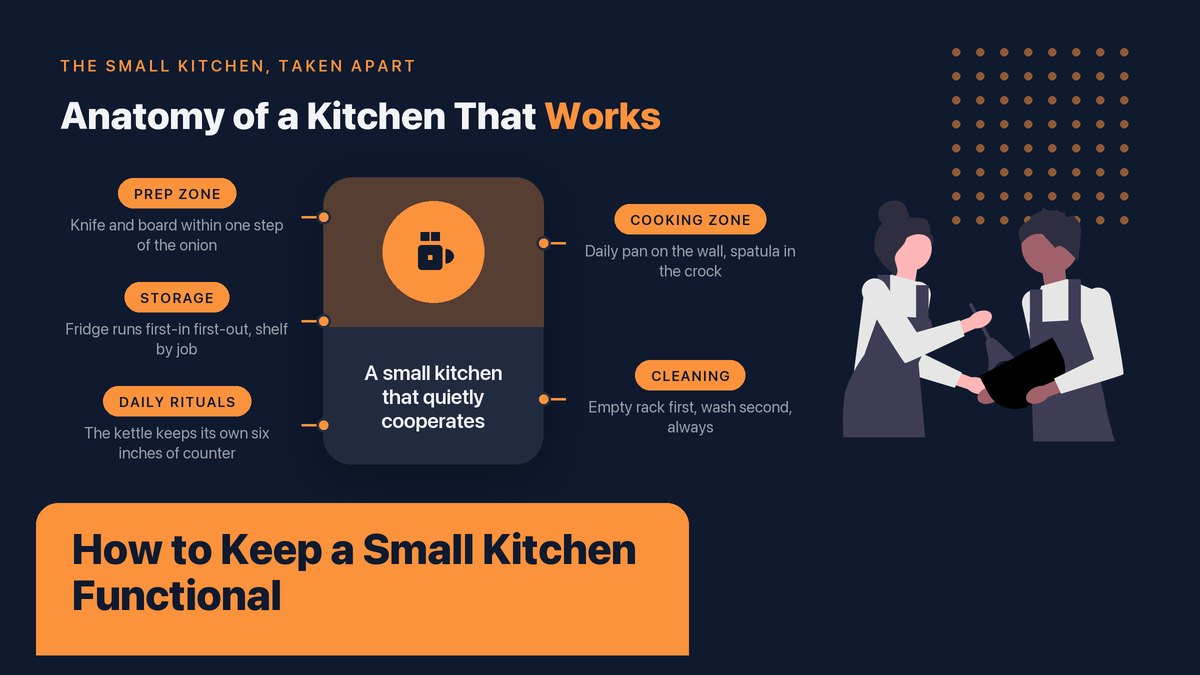
A small kitchen doesn’t need more square footage. It needs fewer decisions, smarter zones, and a habit or two that keep the counters clear when life gets busy.
My first city apartment came with eight feet of counter, one drawer that stuck, and a fridge you could hear humming from the couch. I fought it for a year. Stackable bins, a rolling cart I kept bruising my hip on, one of those over-the-sink cutting boards. The kitchen got more crowded, not more useful. What actually fixed it was boring in the best way. I stopped asking where things should go in an ideal kitchen and started watching where my hands went in mine. The kettle always ended up by the window. The cutting board lived on top of the microwave. The spatula I reached for daily was buried in a drawer with nine other spatulas. Small kitchens don’t punish you for lack of space. They punish you for organizing in your head instead of on the ground, and the punishment shows up as a thousand small annoyances every week that you only notice once they finally stop.
That’s the premise of this whole guide. Nothing here needs a renovation, a landlord’s permission, or a single trip to a specialty store. Some of it asks you to get rid of things, which is the part everyone resists, and I’ll get to it gently. By the end you’ll have a working map of your own kitchen: five zones, one vertical ladder, a gadget drawer on a diet, and a ten-minute reset that keeps the machine from gumming up. An afternoon’s work, give or take, less if you don’t stop to wipe every shelf twice.
In this article
Start With Zones, Not Storage
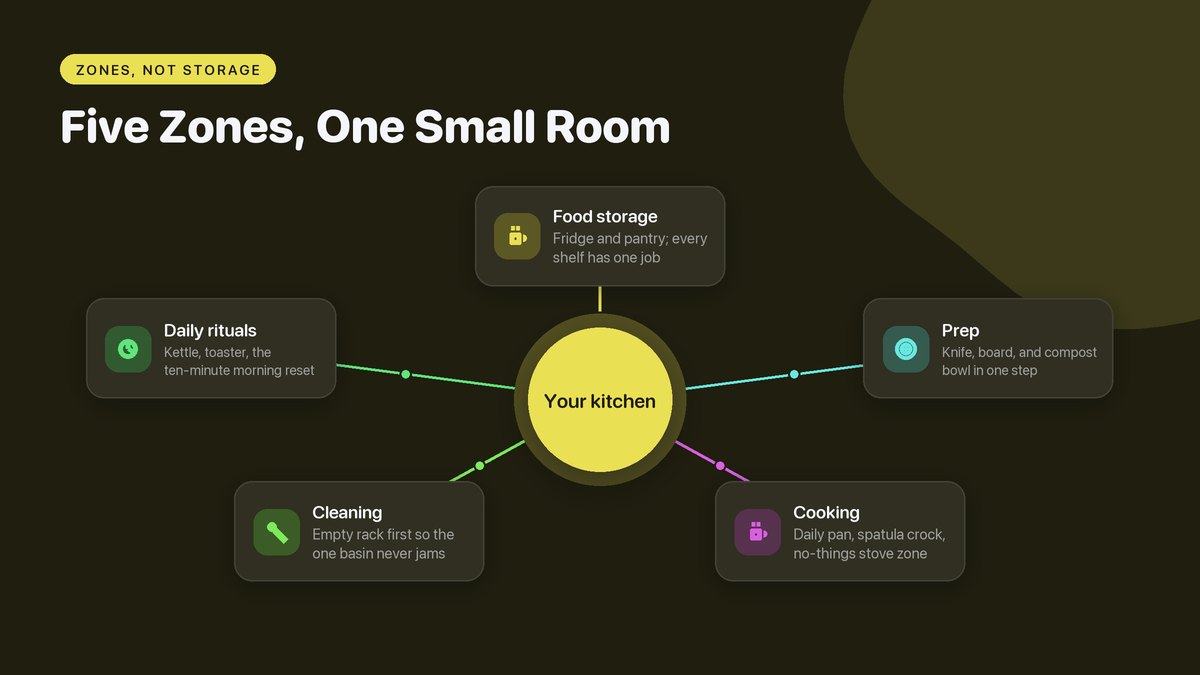
Most small-kitchen advice begins with containers. Bins, racks, the lazy Susan. But containers are the last step. The first step is deciding what actually happens in your kitchen, because a kitchen that works is one where everything you need for a task sits within a single step of where that task happens.
Walk through a normal week of cooking and the same five activities keep showing up. Storing food, prepping it, cooking it, cleaning up, and the small daily rituals around the edges, coffee and toast chief among them. Those are your zones. Big kitchens give each zone its own counter; small ones make zones share, which works fine as long as each zone’s tools live at its station instead of scattered wherever they happened to fit. Try the onion test. Stand where you’d chop an onion, then notice everything your hand reaches for over the next two minutes, knife, board, compost bowl. All of it should be there without a single step.
Zone thinking also kills the junk-drawer problem at its root. A tool without a zone is clutter with a handle.
A Quick Zone Audit You Can Do Tonight
Don’t reorganize anything yet. Cook one ordinary meal and just pay attention. Count the times you crossed the kitchen for something, the drawer you opened twice hunting the same tool, the counter corner where dirty dishes pile up because the sink feels two steps too far away. Those observations tell you more about your kitchen’s real layout than any floor plan ever will, and each one is a one-item fix. Move the compost bowl to the prep counter. Promote the daily spatula to the crock by the stove. Tiny adjustments, but they compound fast.
The Vertical Ladder
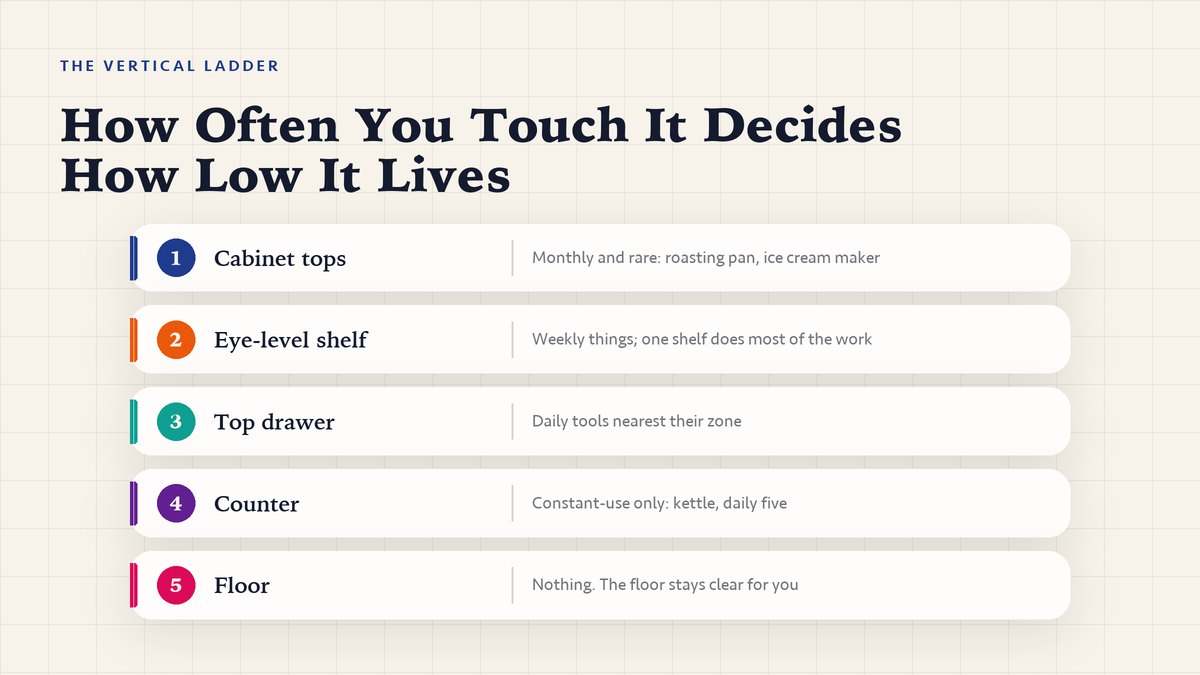
Floor space is the scarcest thing in a small kitchen, and almost nobody uses the other dimension properly. Between the tops of your cabinets and the ceiling there’s usually five to seven feet of empty air, and then there are the door backs, the side of the fridge, the wall above the counter. It all just sits there. Treat all of it as a ladder, and put things on the rung that matches how often you touch them.
Daily items get the counter or the top drawer nearest their zone. Weekly items go in the cabinet at eye level, which in most small kitchens means one shelf ends up doing most of the actual work. Monthly and occasional things climb higher. The roasting pan, the ice cream maker, the twelve stemless wine glasses from a phase, all of it belongs on the top shelves and cabinet crowns where a stool reaches it but your Tuesday self never has to. And the floor itself stays clear, because a rolling cart parked in a narrow galley is a hip-height obstacle you’ll curse on day one and stub your toe on by Friday.
The insides of cabinet doors deserve their own mention, since they’re the most underused square footage in the whole room. A cheap adhesive hook inside the door under the sink holds the dish brush and the towel that would otherwise camp on the counter. A slim rack on the pantry door takes the foil, the wrap, and the parchment out of the drawer they keep jamming. One caution. Nothing heavy on a door you open a dozen times a day, and nothing on a cabinet above the stove, where heat makes adhesive give up in about a month. Ask me how I know.
And one warning about the vertical push. Leave one stretch of wall and one stretch of counter completely bare. A kitchen where every surface holds something starts to feel like a pantry with a stove in it, and wiping a crowded counter takes three times as long because you’re relocating twelve objects before you can even see it. That empty run of counter near the sink will slowly become the most useful tool you own.
This is where ten minutes of scrolling a kitchen showroom actually pays. The IKEA kitchen gallery is worth your time for one reason. Manufacturers spend fortunes solving exactly your problem, and the ideas are free to steal. Rails on the wall instead of knife blocks, hooks under shelves, shelf risers that double cabinet height. I’ve borrowed the rail-and-hook trick from three different showrooms now, and it has never once fallen off the wall, which is more than I can say for my early adhesive organizers.
Put the Gadget Drawer on a Diet
Every small kitchen has one. The drawer, or cabinet, or tote on top of the fridge where single-purpose gadgets go to wait. The avocado slicer, the egg separator, the spiralizer from January, three can openers because each was slightly less bad than the last. The drawer isn’t evil. It just never gets audited, year after year, because everything inside it is small enough to ignore and nobody ever empties the thing out just to look.
Empty it all onto the counter. I’ll wait. Now sort into three piles, and be honest, because this drawer is where honest sorting pays most. Pile one holds what you used in the last month. Pile two holds what you used in the last year, with a specific memory attached. Pile three is everything else, and it usually turns out to be more than half. Pile three gets boxed, and the box goes to the trunk of your car or the front hall rather than back into storage. If ninety days pass without you opening it, donation takes it unopened. That sounds harsh. In practice it’s gentle, since you can pull anything back during the trial, and almost nothing ever gets pulled.
What stays deserves better housing. In a small kitchen the best drawer organizer is often a set of cheap cutlery trays turned sideways, or a few small boxes that keep the baking tools and the measuring tools from melting into one big pile. And on the pantry side of this exercise, the National Center for Home Food Preservation at the University of Georgia keeps plain-language guides to food storage that double as a useful audit, because half of what crowds small kitchens is food kept in its original half-empty packaging.
A Home for the Daily Five
Zones and ladders are the architecture. Now for the five objects that decide whether your morning runs smooth. In almost every household, five tools do most of the daily work: the chef’s knife, the cutting board, the one pan, the spatula, and the kettle. Give these five dedicated, permanent homes at their stations and you’ll feel the difference within a week.
The knife lives on a magnetic strip or in a slot insert at the prep zone, never loose in a drawer where the edge bangs against everything. Buy the strip. The cutting board stands vertically in a cabinet slot or hangs on a hook, because a flat board buried under other flat things gets skipped. The daily pan hangs on the wall or lives in the oven, a trick half of Europe runs on, instead of sitting nested under four pans it never consented to share with. Spatula and spoon go in a crock by the stove where you can grab one without looking. The kettle gets its own outlet, its own six inches of counter, and permission to never move. Which sounds silly, right up until you count the mornings that begin with hunting for the kettle.
A functional kitchen is one where you can cook breakfast half-asleep without opening a single drawer twice.
Everything else in the kitchen is secondary to these five, and when space forces a choice, the daily five win. That’s the honest hierarchy. It beats the usual drift, where the ice cream maker gets prime cabinet space because it was a gift and the knife block gets squeezed out entirely.
Run the Fridge Like a Small Business
The refrigerator in a small kitchen works harder than any other appliance in the room, and it fails in predictable ways. Leftovers migrate to the back and fossilize. Condiments colonize the door. Produce dies in the bottom drawer because nobody could see it. Restaurants solved this ages ago with a simple discipline, and a home fridge can steal it wholesale.
First in, first out. New groceries go behind the older version of the same thing, so the open jar of salsa gets finished before its replacement is ever cracked. Then assign each shelf a job. Top shelf for drinks and ready-to-eat food, middle for dairy and leftovers, bottom (the coldest shelf) for raw meat resting on a tray so nothing drips, crisper for vegetables with the humidity slider actually used. The door is the warmest zone and belongs to condiments alone, which tolerate temperature swings fine, so milk and eggs live on a proper shelf where the temperature actually stays steady. When you’re unsure how long anything keeps, the cold food storage charts at FoodSafety.gov are the reference I check, and they get pleasingly specific about how long eggs and cooked meat actually keep.
One structural habit pays for everything. Ten minutes before grocery day, wipe the fridge down, toss the two fuzzy containers, and write the week’s actual gaps on the list. It also keeps a small fridge from hiding food until it’s past saving, which is the quiet way small-kitchen households waste money, since a head of lettuce you forgot you owned costs exactly the same as one you threw out on purpose. Small fridges overflow fast, and an overstuffed one runs less efficiently too, because cold air needs room to move. ENERGY STAR’s refrigerator guidance covers the settings side of all this. Thirty-seven degrees for the fridge, zero for the freezer, coils dusted once a year, and the door gasket checked with a dollar bill. If the bill slides out easily with the door closed, the seal is leaking cold air and the motor is working overtime to compensate.
Counter Space Is Made, Not Found
You will not find more counter in a small kitchen. You’ll make it, in thirty-second increments, by treating a clear counter as a state that decays instead of one that simply exists. The physics of clutter are merciless. Every flat surface collects stuff at a rate proportional to how empty it is, so accept that and you can stop blaming yourself for the pile by the toaster.
The fix is a landing-spot policy. It sounds fancy. It’s really three rules with a name. Rule one, everything that lives on the counter must earn its place by being used daily. Rule two, anything that lands there without a home gets one within twenty-four hours or it leaves. Rule three, the counter beside the stove stays clear during cooking, because that’s your working surface, the only one that matters at 6:40 pm on a Tuesday. Mail, your wallet, the charging phone, everything pocket-sized lands in one small tray at the kitchen’s edge, which contains the drift and gives you a single place to check when something goes missing.
| Habit | Time cost | What it buys you |
|---|---|---|
| Fridge wipe-down before grocery day | 10 min, weekly | No science experiments, smaller shop, fridge runs cooler |
| Clear counters while dinner simmers | 5 min, nightly | A working surface every evening and a calmer morning |
| Dishwasher or rack emptied every morning | 4 min, daily | Dirty dishes never stack in the sink and block the one big basin |
That third row earns a paragraph, because the single most common small-kitchen failure mode is the occupied sink. One basin, full of last night’s dishes, and the entire cleanup chain jams behind it. Empty rack first, wash second, always. It feels pedantic. It saves maybe twenty minutes a day, which adds up to something like a hundred hours a year you’d otherwise spend shuffling dishes around like a very dull puzzle.
Two Safety Margins Small Kitchens Must Keep
Tight kitchens squeeze out the safety gaps that bigger ones absorb without anyone noticing. Two of them matter enough to say plainly.
Stove clearance comes first. Potholders, paper towels, packaging, dishcloths, all of it drifts toward the burners because that’s where the action is, and fabric or grease near an open flame is how most home cooking fires start. Keep that zone clear. Keep a no-things zone about the width of the stovetop on both sides, and keep a lid or a box of baking soda within reach of the stove, since smothering a small grease fire beats throwing water on it, which just spreads burning oil. The U.S. Fire Administration’s guidance on preventing cooking fires is short and worth reading once, especially the parts about unattended pans and what to actually do in the first ten seconds of a stovetop fire.
Electrical is the second margin. Small kitchens overload circuits in a very particular way. The toaster, the kettle, and the microwave all want the same outlet at 7 am. Countertop appliances draw real current, and a power strip daisy-chained into an extension cord behind a cabinet is a slow problem you won’t notice until it isn’t. Spread the heavy hitters across two outlets, keep cords clear of the sink and the stove, and unplug the rare-use appliances instead of letting five wall warts squat there permanently. Your future self, the one with a working kettle and no scorch marks, will thank you.
Light is the third, smaller but real. Small kitchens often run on a single overhead fixture that leaves the counter where you actually chop in your own shadow. A battery LED strip under the wall cabinet costs about fifteen dollars, sticks on in five minutes, and peels off again without leaving a mark, which makes it just about the only upgrade a rental agreement actually allows. It sounds like a luxury. It isn’t. Knife work under decent light is safer and faster, and it softens the end of a long workday.
The Ten-Minute Reset
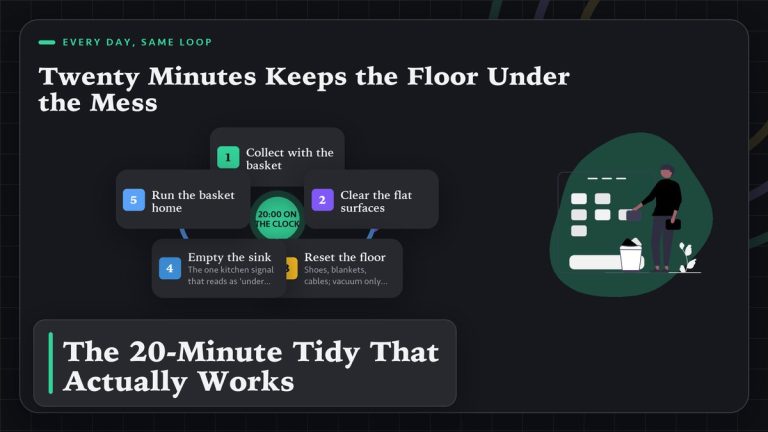
Everything above is setup. This is maintenance, and it’s what separates kitchens that stay functional from ones that slide back within a month. Once a day, ten minutes, same rough time. Not a deep clean. A reset.
Run it as a fixed loop so it doesn’t require thought at the end of a long day. Clear the counters back to the landing tray. Empty the dish rack or dishwasher. Wipe the one counter that matters. Sweep the floor if it needs it, which in a small kitchen takes about ninety seconds. Then set the kitchen back to ready-for-tomorrow and stop, even mid-task. Ten minutes, timer on your phone, done beats perfect here. I do mine while the kettle heats in the morning. The routine snapped into place after maybe two weeks, and the kitchen has not once returned to the post-dinner swamp it used to become.
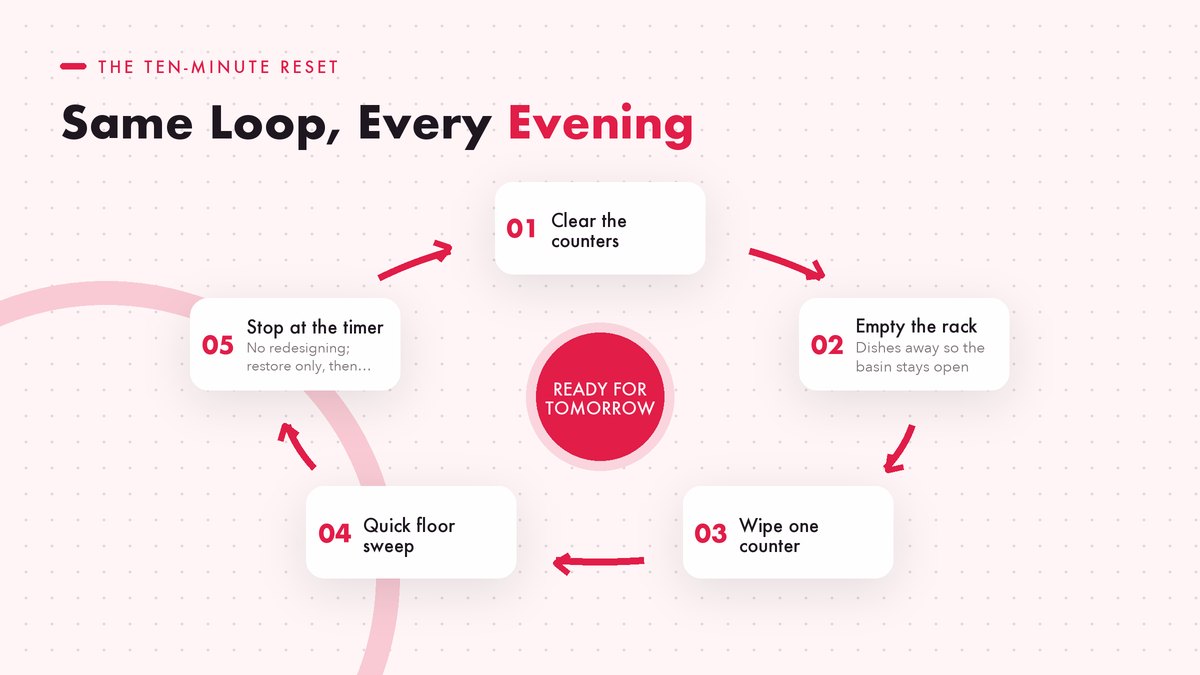
What you don’t do in the reset matters as much. No reorganizing, no reorganizing-adjacent fiddling, no deciding where the whisk “really” belongs. The reset restores. It never redesigns. Redesigning happens on the weekend, deliberately, maybe once a season, when you can actually think. Mix the two and the reset quietly stretches to forty minutes, and then it gets abandoned. Consistency is the entire trick.
If You Do Nothing Else
Small kitchens reward consistency over cleverness. The bins, the racks, the carts, all of it is decoration on top of a simpler skeleton. Zones where tools live at their stations. A ladder that puts daily things low and rare things high. A gadget drawer that got honest with itself. And a ten-minute daily reset that keeps the machine tuned. Get those four running and the kitchen stops being the room you avoid. It becomes, more or less, a place that quietly cooperates.
Start tonight if you like. One drawer, the timer on your phone, ten minutes. The rest can wait for the weekend. Honestly, some of it can wait until next month.
Sources checked November 2026: FoodSafety.gov cold storage charts, ENERGY STAR refrigerator guidance, U.S. Fire Administration cooking-fire prevention, National Center for Home Food Preservation (UGA), IKEA US kitchen gallery. Update policy: kitchen links and temperatures re-verified each revision.