You don’t need a free evening to get better at guitar, Spanish, coding, or bread baking. You need twenty focused minutes and a plan for how to spend them, and the plan matters far more than the clock time.
Say you’ve got a friend, call him Dave, who’s wanted to learn guitar for the better part of six years. He owns a decent acoustic, a clip-on tuner, and a beginner songbook gathering dust on the hallway shelf. Ask him why he hasn’t made progress and he’ll tell you, without a flicker of irony, that he “doesn’t have time to practice.” Dave watches about two hours of TV most nights, which is where his evenings actually go. Every single night. What he lacks is a solid two-hour block he can give to guitar, and almost nobody with a job and a sink full of dishes has one of those. I spent years believing this was a real obstacle before it dawned on me that it isn’t one. Twenty minutes spent well beats a marathon session that exists only in good intentions, and this article is the system I eventually built and wish someone had handed Dave. How to carve a real practice session out of a sliver of evening, what to do inside those minutes, and how often you need to show up before the progress becomes visible.
In this article
- Why Twenty Minutes Is Enough (If You Spend It Right)
- What Actually Counts as Practice
- The 20-Minute Session, Minute by Minute
- Spaced Repetition: The Part That Makes It Stick
- The Weekly Rhythm: How Often Beats How Long
- A Two-Week Starter Plan You Can Steal
- The Mistakes That Eat Your Twenty Minutes
- Choosing a Skill That Fits the Twenty-Minute Format
Why Twenty Minutes Is Enough (If You Spend It Right)
The objection comes up every time, so let’s take it head on. Twenty minutes feels too thin to learn anything real, like trying to fill a bathtub with an eyedropper. Yet the research on how people learn keeps pointing the same mildly annoying direction. Shorter sessions repeated across days tend to stick better than one long binge. The American Psychological Association’s rundown of common learning myths explains why. Massed practice, meaning all your work crammed into a single sitting, feels productive in the moment and then forgets itself within weeks. Weeks at best. Distributed practice, the same total time spread over more days, feels harder and slower while you’re doing it, and the skill is still there a month later.
And the numbers back this up across a lot of different materials. A meta-analysis of verbal recall studies, published through the U.S. National Library of Medicine, found that people who spread sessions out retained dramatically more than people who matched them hour for hour in one sitting. Give or take the specifics of the task, the spacing advantage held up across ages and subject matter. So do the honest math with me. Three twenty-minute sessions on Tuesday, Thursday, and Saturday make an hour of practice, and it’s an hour that mostly stays with you. The two-hour Sunday binge that skipped Saturday is also an hour, and a good slice of it evaporates by the following weekend. The first schedule fits between dinner and the dishes. Nothing else in the day has to move.
There’s a second reason short sessions work, and it has nothing to do with studies. A twenty-minute commitment is small enough that you keep it. I’ve abandoned my share of grand plans, and the “an hour a day, every day” variety tends to die around day four, usually on a Tuesday when work runs long and the couch wins the argument. Twenty minutes changes the negotiation with yourself. You’re not rearranging the evening; you’re pausing it. That’s the whole trick.
One more thing worth knowing, because it reframes the whole question. For most of us, high-quality focus on a new skill lasts somewhere in the neighborhood of twenty or thirty minutes before it starts to degrade. Sometimes sooner. You make mistakes you wouldn’t make fresh, and worse, you stop noticing them. Beginners hit that wall sooner, since nothing about the skill runs on autopilot yet. A short session isn’t a compromise with your schedule. For a beginner it roughly matches how long the practice stays good. Stretch it to two hours and you get the same twenty quality minutes, padded with ninety minutes of declining returns, and those flailing final repetitions can cement the wrong version of everything you worked on. Short is the honest shape of the session.
What Actually Counts as Practice
Part of the problem is that “practice” means different things to different people, and the loosest definition does most of the damage. Nobody means to. Playing the three songs you already know on guitar while the TV runs in the background is playing, nothing more. Pleasant, relaxing, worth doing on its own terms, but your fingers aren’t learning anything new and neither is your brain. Working through the opening chords of “Wonderwall” for the hundredth time is the skill equivalent of walking the same three blocks every day and wondering why you’re not getting fitter.
Actual practice has a recognizable shape. Musicians and coaches call the gold standard deliberate practice, and the full academic version of that idea is demanding enough to scare people off, so the plain-English version goes something like this. You work on something just past your current ability, you can tell fairly quickly whether you did it right, and you give it your full attention the whole time, which is where the television gets switched off.
This definition changes everything about how you spend a short session. If practice means pushing on the edge of what you can’t quite do yet, then twenty minutes isn’t a shrunken long session. It works more like a laser. Pick one narrow weakness, attack it for a bounded stretch, and stop before you get sloppy, because sloppy repetitions teach your hands or your pronunciation or your typing the wrong version of the thing, and un-teaching costs more time than the practice saved.
Twenty minutes aimed at the exact thing you can’t do yet will move you further than two hours of comfortable noodling. It’s less fun, and that’s why it works.
The 20-Minute Session, Minute by Minute
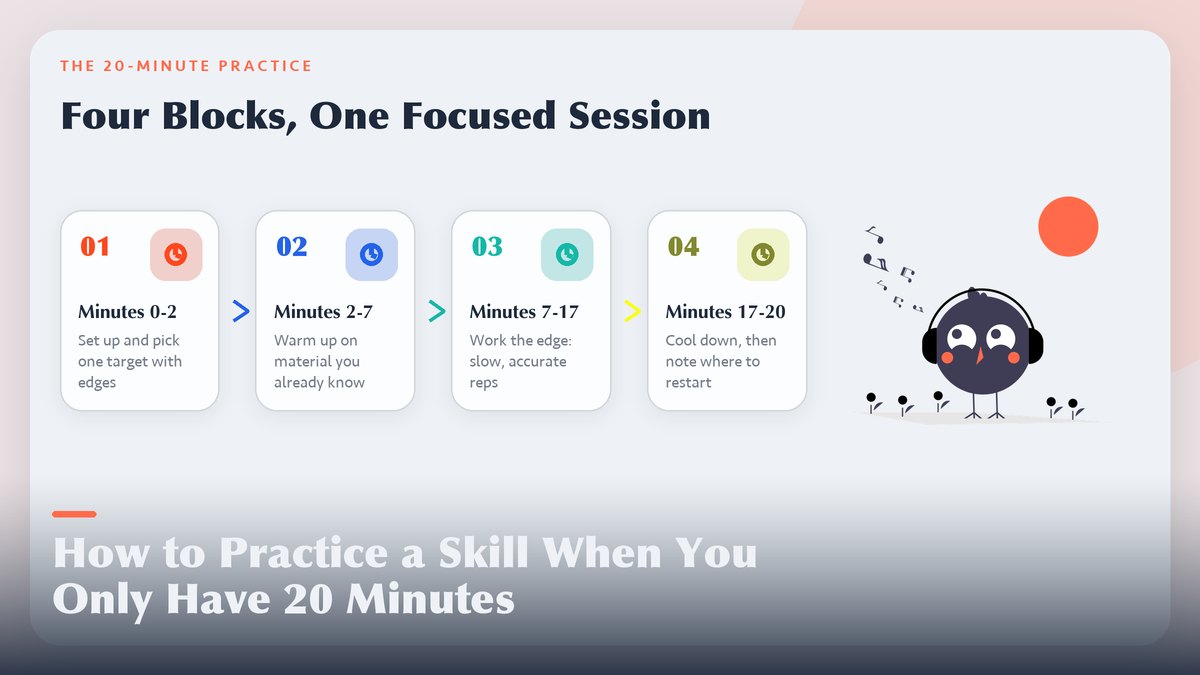
The default template — adjust the middle block to fit your skill
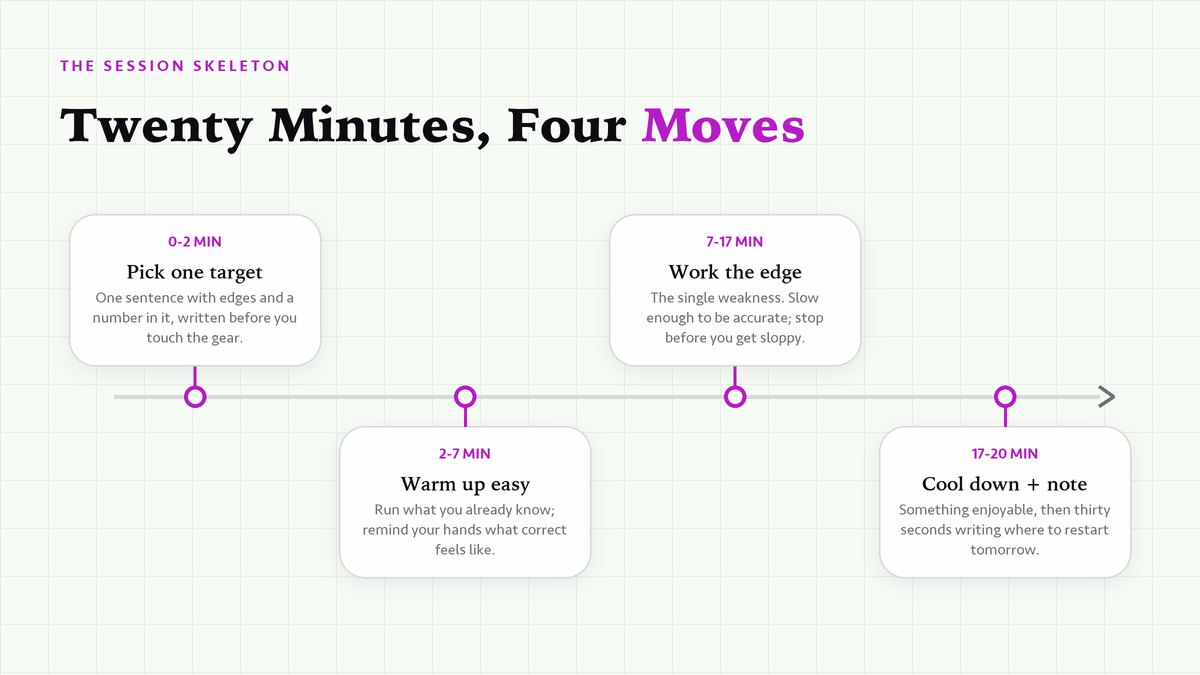
Structure is what protects you from the classic short-session failure, which is spending eleven of your twenty minutes getting ready to practice. Eleven minutes, gone. Tuning, scrolling, and hunting for the right tutorial video. The skeleton below has the proportions already baked in. It looks rigid on paper; it isn’t in use. Treat it the way you’d treat a recipe, one you follow closely until you can cook the dish without it.
Minutes 0–2: Set up and pick today’s target
Decide on one thing before your hands touch the instrument, the keyboard, or the vocabulary list. “Practice guitar” has no edges. “The F-to-C chord change at half speed, eight clean reps” has edges, and so does “yesterday’s thirty Spanish words, spoken out loud, no peeking.” Write it on a sticky note if your memory is as sieve-like as mine. A vague target turns twenty minutes into a warm-up with no main event attached.
Minutes 2–7: Warm up on something easy
Run the material you already know, at a comfortable speed. This stretch isn’t wasted, because you’re reminding your body and brain what “correct” feels like before you ask them for something harder, and you’re lowering the friction between yourself and the main block. Five minutes is the ceiling. It’s far too easy to camp here, since easy material feels good, and this is where the timer earns its keep.
Minutes 7–17: The main block — work the edge
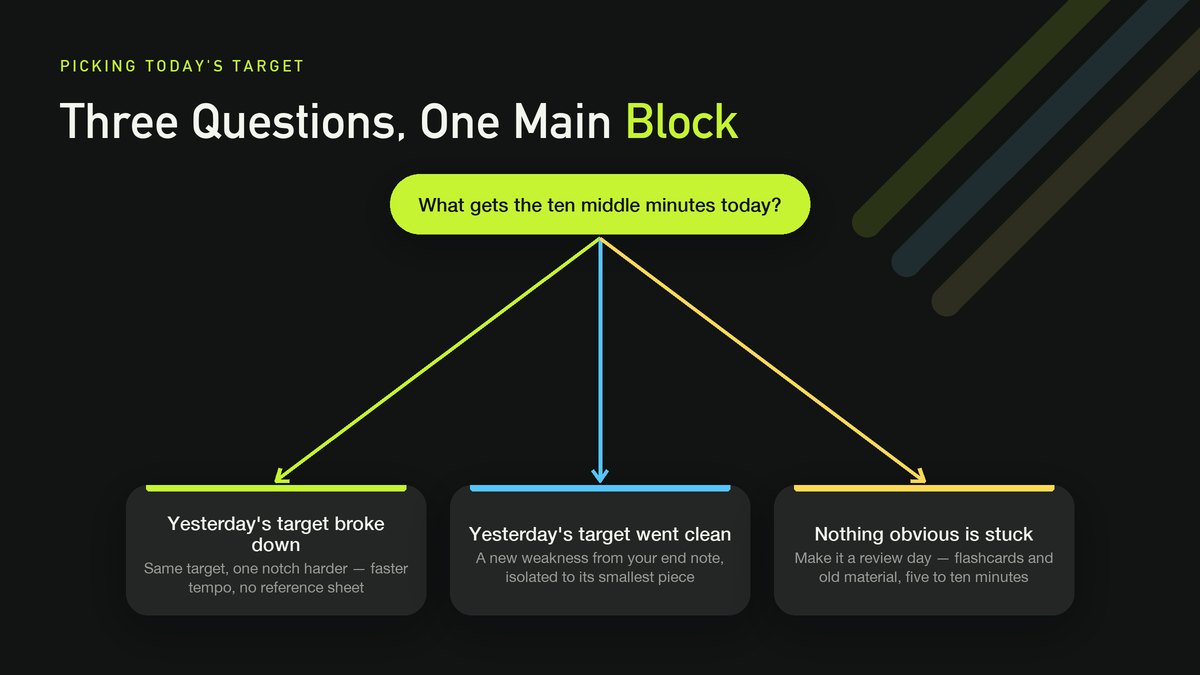
Ten minutes on the target you picked. Go slow enough to be accurate, because speed is a garnish and accuracy is the meal. When you nail it, nudge the difficulty up one notch, faster tempo or harder words or no reference sheet. When you blow the same passage three times in a row, drop back to the last version you could do cleanly and rebuild from there. The entire game in this block is staying inside the narrow band between boring and hopeless.
Minutes 17–20: Cool down and leave a note
Finish with something you enjoy, partly as a reward and partly so the session ends on a version of the skill that feels good in your hands. Then spend thirty seconds writing down where you stopped and what the next session should attack first. I’ve come to believe this note is the single most useful habit in the whole system. It turns tomorrow’s target-picking into a ten-second job instead of five minutes of dithering, and dithering is where sessions slowly bleed out. Future you says thanks.
One setup detail pays for itself many times over. Keep the gear visible. The guitar lives on a stand in the living room, the sketchbook lives on the kitchen table, the language app sits on the first screen of your phone. Every step between “thinking about practicing” and “actually practicing” is a spot where the habit can die, and the habit research is blunt about this: friction, far more than motivation, is what kills regular behavior. Ten seconds of fetching a guitar from the back of a closet doesn’t sound like a real obstacle until you catch yourself skipping a whole week of sessions because of it. Dave’s guitar stand, incidentally, is what finally got him playing, and it cost eleven dollars. Money well spent.
Spaced Repetition: The Part That Makes It Stick
Whatever the skill, some of it lives in muscle memory and some of it lives in plain memory. Vocabulary, chord names, syntax, scale patterns, recipe ratios. For that second category there’s a technique with an unglamorous name and an impressive track record: spaced repetition. The idea traces back to Hermann Ebbinghaus, who in the 1880s measured how fast he forgot nonsense syllables and drew the famous forgetting curve, which says most forgetting happens fast, within a day or two, unless something interrupts it.
Interrupting it is simple in concept. Simple to say, anyway. Review the material just as you’re about to forget it, and each review makes the memory stronger and longer-lasting than the last. The problem is that the scheduling math gets tedious fast, which is exactly why apps exist. The best-known free one is Anki, a flashcard program whose official manual lays out the scheduling logic in detail; it surfaces each card right before the algorithm predicts you’d forget it. Ten minutes of Anki a day can hold thousands of facts in working order, which is why medical students and language learners lean on it so heavily.
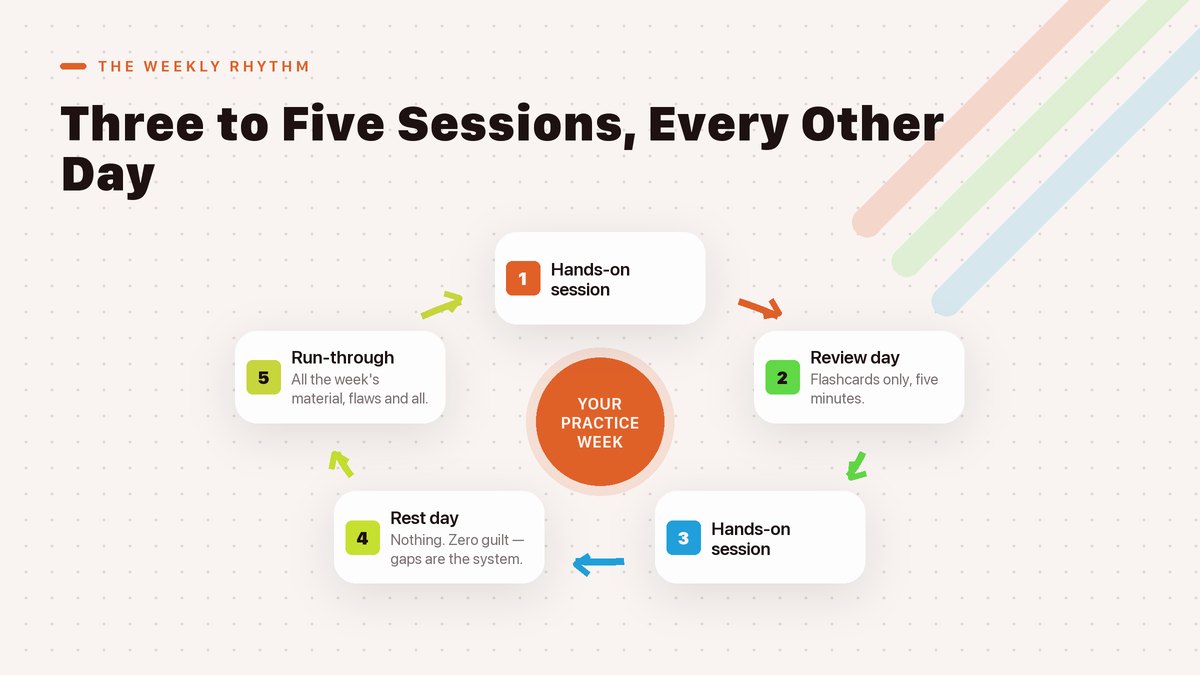
Inside your twenty-minute system, you’ve got two workable arrangements. Run a five-minute review at the start of every session, or split the days, with odd days for hands-on work and even days for flashcards. Either works. The trap to avoid is letting spaced repetition replace practice altogether. Knowing the name of every guitar chord and being able to change between them at tempo are different skills, and flashcards only build the first one. Plenty of language learners fall into this hole, collecting two hundred German nouns and then remaining unable to order a coffee in Berlin. The nouns were flawless. The coffee never arrived.
A few weeks in, add one related technique: interleaving, which means you mix related skills rather than drilling a single one to death. A pianist who alternates between two tricky passages learns to tell them apart far better than one who hammers a single passage for an hour straight. The mixing feels worse while you do it, and once again it retains better afterward. Adopting it inside a twenty-minute session costs you nothing, since you’re already working in small blocks. Swap the main block between two targets across the week, say Mondays and Thursdays on the chord change, Tuesdays and Fridays on the strumming pattern, and let them reinforce each other.
The Weekly Rhythm: How Often Beats How Long
Once a session works, scheduling becomes the next question, and it’s where people quietly sabotage a good thing. The instinct is to bank sessions, to stack everything into one big Saturday push. Resist that instinct. Spacing works best when the gaps stay reasonably even, and there’s a practical side too. One missed Saturday erases your entire week, while a missed Tuesday inside a four-session week is a 25% setback you can shrug off before lunch.
The rhythm I keep returning to, for myself and for anyone who asks: three to five sessions a week, roughly every other day, twenty minutes apiece, each one pinned to something that already happens. “After I pour my coffee on weekdays” will outlive “whenever I feel like it” by a mile, because the trigger already exists and demands no fresh decision. I said twenty minutes earlier, and for a total beginner I’d honestly start with ten and build up, since the habit matters more than the duration at the beginning. Three sessions a week across a full year is roughly fifty hours of distributed, deliberate practice. That’s not the schedule of someone dabbling. That’s a real skill arriving on your doorstep.
Miss a session? The rule is boring and strict at the same time. Never miss twice in a row, and never try to make up a lost session by doubling the next one. Doubling drags you straight back into marathon thinking, and marathon thinking is what stalled Dave for six years. Just do the next session as planned. The compounding doesn’t care about your bad week; it cares whether you’re still showing up in February.
A Two-Week Starter Plan You Can Steal
Below is a concrete fourteen-day version built for a generic skill, guitar, piano, drawing, a language, coding, whatever you’re learning. Adapt the middle column to your own thing and keep the shape of the plan intact.
| Day | Session focus | The one target to write down |
|---|---|---|
| 1 | Baseline + setup | Record where you are now (a 30-second clip, a drawing, a timed drill) so week two has something to compare against |
| 2 | Warm-up + first edge | One weakness, isolated: a single chord change, ten words, one line of code typed without peeking |
| 3 | Review day | Flashcards or notes from day 2 only — keep it light, five to ten minutes counts |
| 4 | Main block, same target | Same weakness as day 2, one notch harder; note whether it got easier |
| 5 | Rest | Nothing. Zero guilt. Spacing needs gaps to do its job |
| 6 | Warm-up + old material | Everything from days 1–4, run start to finish without stopping to fix |
| 7 | Free play + review note | Whatever you enjoy, plus two sentences: what improved, what’s still stuck |
| 8 | New target | Second weakness, chosen from last week’s “still stuck” note |
| 9 | Review day | Flashcards covering both weeks now |
| 10 | Main block | Second weakness, one notch harder |
| 11 | Interleave | Alternate old target and new target in short bursts — five minutes each, twice |
| 12 | Rest | Again: nothing |
| 13 | Full run-through | All material from both weeks, performed without stopping, flaws and all |
| 14 | Measure | Redo day 1’s baseline. Compare. That gap is what twenty minutes buys you in two weeks |
Day 14 is the step people skip, and it’s the one that keeps the whole machine running, because the comparison is your fuel for the next month. Progress you can’t see is progress you quit. After the first two weeks, keep the skeleton and rotate fresh targets into the middle column.
The Mistakes That Eat Your Twenty Minutes
Most short practice attempts don’t fail because the science is wrong. They fail on a handful of predictable, fixable habits, and I’ve committed every one of them at some point, a couple within the last year.
- Preparing to practice. Tuning, organizing files, choosing a tutorial, and straightening the desk. Cap setup at two minutes, hard. If a resource takes longer than that to start, pick a worse one that starts faster.
- No defined target. “Practice Spanish” is a mood. Every session needs one sentence with a number in it. “Thirty words.” “The chorus at 80% speed.” That level of specificity.
- Practicing the fun part. Left alone, you’ll spend all twenty minutes on what you’re already good at, because comfortable material gets zero scheduled minutes; it’s the warm-up and the cool-down, nothing in between.
- Late-night practice while exhausted. A groggy session teaches you to associate the skill with tiredness, which is a bad trade for everyone. If your only window is 11:30 p.m., cut the session to ten minutes rather than letting it slide later.
- Skipping the end note. Without it, every session starts cold and burns five minutes re-deciding what to do. Thirty seconds of writing is the cheapest speed-up in the entire system.
- Bailing on the awkward plateau. Somewhere around weeks three to six, progress goes quiet. This is normal, and it’s where most people quit. The plateau isn’t the skill stopping; it’s the skill consolidating while you catch up to it. Keep the rhythm and walk through.
Choosing a Skill That Fits the Twenty-Minute Format
Nearly any skill gains from short sessions, but some decompose into daily chunks better than others, and picking one that fits your actual life is half the battle before you start. Instruments, vocabulary work, drawing drills, typing, and coding exercises all break apart beautifully. Skills that need long uninterrupted stretches just to set up, anything involving a two-hour kiln firing, say, can still work, but your twenty minutes go to sub-skills instead, sketching the piece, planning the glaze, or reading up on technique. That’s not a consolation prize. Sub-skills are where the real competence gets built anyway.
If you’re still choosing what to learn, our guide to picking up a hobby without buying too much gear pairs naturally with the short-session mindset, and the piece on free resources worth your time will save you from paying for anything before you’ve earned it with your evenings.
And one last thought, the one I’d put on a sticky note if I could. The point of the twenty-minute system was never to become world-class. It’s to become the kind of person who practices, regularly and unremarkably, without turning it into a production, with the skills piling up almost as a side effect. Dave, for the record, finally put a stand in his living room and plays fifteen minutes after dinner most nights. He’s four months in, and last week he played an actual song at an actual campfire. It came out a little rough. Nobody minded in the slightest.
Further reading on this site: How Long It Really Takes to Learn a New Skill · How to Actually Finish Books You Start. External sources cited above: the American Psychological Association on learning myths, a U.S. National Library of Medicine meta-analysis on distributed practice, the Wikipedia entry on the forgetting curve, and the official Anki app and manual.