There’s a version of flight hunting that eats your entire evening and saves you eleven dollars. There’s also a version that takes about fifteen minutes and usually beats it. This is the second one.
A friend of mine once spent four evenings comparing flights for a trip to Denver. Four evenings. She had spreadsheets, six browser tabs open at any moment, and a strong opinion about which Tuesday was cheapest. When she finally booked, I ran the same dates through the setup I’m about to describe. Twelve minutes, give or take. My fare came in about sixty dollars under hers, and she was, understandably, annoyed.
None of that was luck or a secret coupon code. She was doing what most of us were taught to do: search a lot, compare everything, wait for a drop. The advice dates back to when fares changed once a week and got printed in the Sunday paper. These days a price can move several times a day, and most of those little wiggles are noise your extra searching can’t influence. More searching mostly feeds anxiety and feels productive while the number sits still.
The better approach runs the other way. Set up a small system once, let it watch prices for you, and spend your real effort in the two places where effort actually pays: being flexible, and knowing when to stop. The rest is theater. Let’s build it.
In this article
- Why Searching Harder Stops Working
- The 15-Minute Setup That Does the Watching for You
- The Booking Window, Without the Superstition
- Which Tool Does Which Job
- The Flexibility Multipliers
- Deal Alerts, Mistake Fares, and Other Siren Songs
- Hacks That Don’t Work (So You Can Stop Doing Them)
- The System in One Checklist
Why Searching Harder Stops Working
A quick reality check on how airline pricing behaves, because once you see it the “search harder” instinct collapses. Airlines price seats with software that reads how full the plane is, what competitors charge, what time it is, and a pile of signals nobody outside the industry fully sees. The U.S. Department of Transportation keeps a consumer page on air travel, and it exists mostly because fares confuse people enough to generate a steady stream of complaints. There’s a reason for that.
Any single price you see is a snapshot of a moving object, and refreshing the page fifty times changes nothing about the motion. Two seats on the same flight can cost different amounts on the same day, and the person who paid less usually was no cleverer. They bought at a different moment, or on a different date, or from an airport an hour away. Timing and flexibility do the work. Refreshing does not.
Then there’s the famous tip about Tuesdays being the cheapest day, and I’d retire it. Fare drops do show up midweek sometimes, but they’re a side effect of airlines reacting to each other, a calendar rule you can’t plan around. If your dates are fixed, the weekday you search on barely moves the needle. The things that move it are what the rest of this article covers.
The 15-Minute Setup That Does the Watching for You
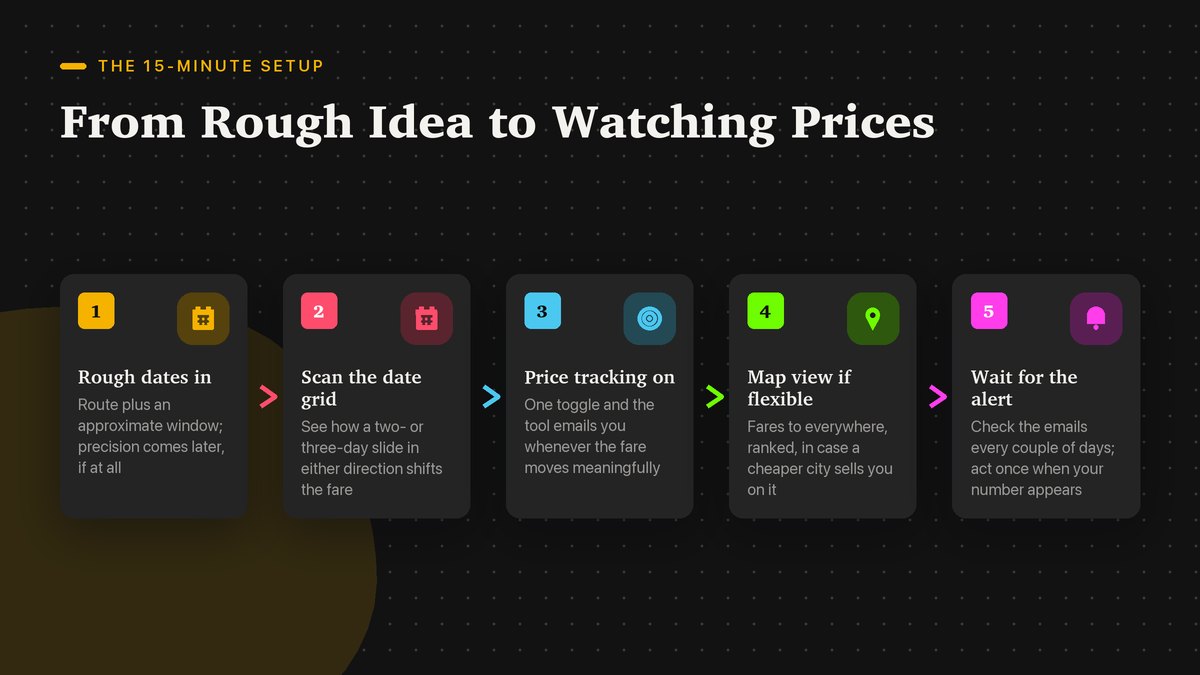
This is the core of the method, and it really does take about fifteen minutes. Open Google Flights, type in your rough route and your rough dates (don’t fuss over precision yet), and do three things.
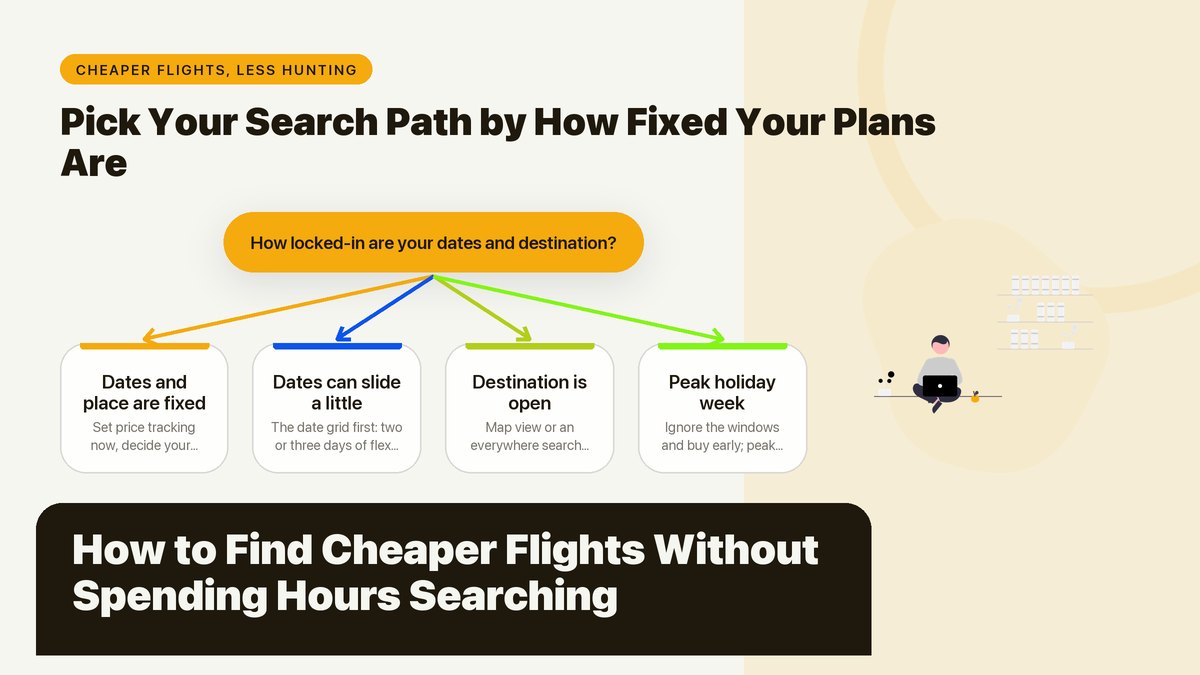
First, look at the date grid. Put in a departure date and Google shows how the fare shifts if you leave a day earlier or later, and how the return date shifts it further. The swings are bigger than most people expect. Sliding a trip by two or three days in either direction often saves fifty to a hundred and fifty dollars per ticket, and the grid surfaces this in five seconds with no spreadsheet anywhere near it.
Second, turn on price tracking for your exact dates. This is the load-bearing step. Google emails you when the fare for your route changes meaningfully, up or down, and that one feature replaces an hour of nightly tab-checking with an email you glance at. I’ve had a tracking alert save me a hundred dollars on a domestic trip, and I’ve had one flag a jump that made me book immediately before it got worse. Both directions earn their keep.
Third, if your destination is flexible at all, check the map view. It shows fares from your home airport to basically everywhere, which is how a “maybe we go to Portland” conversation becomes “Portugal is somehow cheaper, how is Portugal cheaper.”
Do those three steps and the system is running. From here you check the emails every couple of days and act on them once. The Bureau of Transportation Statistics publishes actual airfare data if you ever want to see how prices behave across a whole year, and it’s more reassuring than any tip list. Fares are choppier than you’d guess, and steady watching smooths them out.
The Booking Window, Without the Superstition
Everybody wants a magic number, “book exactly 47 days out!”, and the honest answer is that the magic number moves around by route and season. The shape of the pattern is stable enough to plan around, though, and it reads a lot less mystical than the forums make it sound.
Way too early, think eight to eleven months out, fares often sit high because airlines open seats at optimistic prices and only discount later if the plane isn’t filling. There’s a middling zone, maybe four to seven months out, where prices bounce without a strong direction. Then comes a window worth remembering, where fares on domestic U.S. and Canada routes tend to be at their most reasonable. Roughly one to three months before departure for domestic flights, more like two to four months for international trips. After that, on average, fares climb. Gently at first, then steeply in the final two weeks.
I should be careful here, since I just said no superstition and I mean it. Those windows are tendencies, laws they are not. (Sorry.) Holiday weeks and peak summer routes can jump months ahead and stay high, while a half-empty Tuesday flight in February can drop at the last minute. The official government guidance on buying airfare, meaning the DOT’s consumer materials, mostly amounts to buy early for peak periods and compare before you commit. Less exciting than a magic number, sure. Also true.
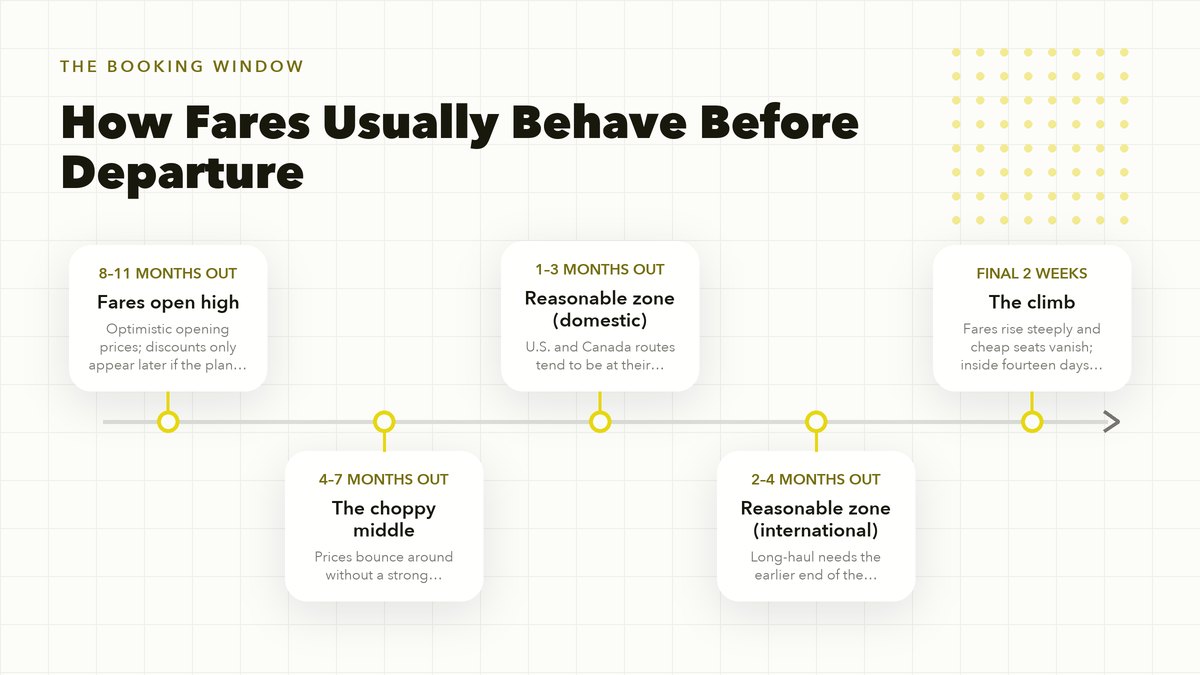
The final two weeks are where cheap fares go to die. Inside fourteen days, if you see a price you can live with, book it and close the tabs.
So how do you use the window in practice? Set your tracking early, four to six months out costs nothing and gives the alerts time to work. When a fare lands inside your “I’d be happy with that” number, book it and be done. Don’t keep tracking after you buy, nothing good comes from watching a price fall after you’ve committed. Fine, one good thing comes of it: you learn whether your threshold was right for next time.
Which Tool Does Which Job
Ten tools is overkill. You need about three, each doing the one thing it’s good at, and that puts you ahead of ninety percent of searchers. The mistake is opening all of them at once and drowning in slightly different numbers. Each site pulls slightly different fare data, and the differences are usually a few dollars and rarely the deciding factor.
| Tool | Best for | Trade-off |
|---|---|---|
| Google Flights | Flexible-date search, the date grid, price tracking, exploring the map | Prices are estimates; you book with the airline, so a rare mismatch can appear at checkout |
| Hopper | Its “wait or buy now” prediction on whether a fare will rise or fall | Predictions are educated guesses, good for indecision but not gospel |
| Skyscanner | Whole-month views and “everywhere” searches for open-ended trips | Some listed fares route you through third-party sellers; book named airlines when you can |
My own workflow for most trips: Google Flights handles everything until the moment of booking, and then I book on the airline’s own website even if a third-party seller shows the same fare five dollars cheaper. That five dollars is insurance. A flight gets changed or canceled, or you mistype a name, and one of these eventually happens to every frequent traveler. The airline’s own customer service line is dramatically easier to deal with than a reseller’s, and the DOT’s consumer resources push the same direction, since your rights and remedies run cleanest when the ticket comes from the airline.
One habit that pays off in the checkout flow itself: check the fare breakdown before you pay. The listed price tends to pick up padding at the last step from seat-selection fees, bag fees, and sometimes a “service fee” that only appears on the final screen. None of it is hidden exactly, airlines have to show the full price including mandatory taxes before you pay, but the optional extras pile up in the background. A fare that looked thirty dollars better can evaporate by the payment page, so get to the final screen, write down the real total, and only then compare against the next option. I screenshot the fare-rules summary on anything nonrefundable too, so “no changes allowed” never ambushes me at the airport.
For open-ended wanderers, Skyscanner‘s “everywhere” search deserves a special mention. Set your home airport, choose “everywhere” as the destination, pick the cheapest month, and it ranks the whole world’s fares from your city. It’s the most fun search box in travel, and I’ve planned two entire trips off its top five results. Hopper I keep around for one narrow job, the price prediction that breaks a tie when a fare is decent and I’m tempted to wait. That’s all it needs to be.
The Flexibility Multipliers
If the setup above is the base layer, this is where the real money hides. Small flexibilities stack, and here’s how I’d rank them by what they typically save.
Your departure airport is the biggest one. Most metro areas have an alternative within an hour or two. New York has three major airports, Toronto two, Chicago two, and fares between them on the same dates can differ by a hundred dollars or more. Check the “nearby airports” toggle before every search. The same trick works at the destination end, and flying into Oakland instead of San Francisco, or Newark instead of LaGuardia, has funded many a nice dinner.
Dates come second, and you already have the date grid for that. Shoulder seasons are the quiet hero. The two or three weeks just before and just after peak season usually deliver the same trip with fewer crowds and noticeably softer fares. Early June instead of mid-July, late September instead of August. The weather is often better too, which feels like cheating.
The trip structure itself is the third multiplier. Round-trips used to be the default because they were priced that way, but on many U.S. routes two one-ways on different airlines now cost the same or less, and they free you to arrive and depart from different cities. Fly into one, road-trip to another, fly home from there. For anyone who was renting a car anyway, this erases a whole backtracking day.
None of this requires heroics. Each move takes a few extra minutes inside the same tools, and together they’re where the “how did you get it that cheap” money actually comes from. Nobody gets there by refreshing.
Deal Alerts, Mistake Fares, and Other Siren Songs
A word on the deal newsletters and flash-sale alerts, because if you travel even occasionally, somebody has told you to sign up for one. I’m not against them, I subscribe to two myself, but it helps to know what they can and can’t do before the daily emails start feeling like homework.
What they’re great at is surfacing genuine sales. Airlines run real, published sales with meaningful discounts, mostly on off-peak routes and empty planes, and a good alert catches them within hours. If your dates and destination are flexible, a well-timed sale is one of the few things that beats the tracking system above, since sales can undercut the normal window logic entirely.
Their weak spot is matching your actual plans. The sale fare is almost never for your dates, your route, or your school-break constraints. It’s for a Tuesday-to-Tuesday trip to a city you hadn’t considered. Wonderful if you’re the sort of person who can restructure a vacation around a price, and some people really can, and I admire them. Useless if you’re visiting your in-laws over Thanksgiving. Be honest about which traveler you are before three newsletters colonize your inbox.
Mistake fares are the next tier down on the legend scale, those pricing glitches where a four-hundred-dollar ticket to Europe briefly rings up at ninety. They do happen, and entire communities exist to catch them within minutes. I’d file this under fun-to-know rather than plan-around. Mistake fares get canceled with some regularity, they favor people who can drop everything and book instantly, and building a travel budget around a glitch is like building a retirement around scratch cards. If you see one and your plans are rubbery, grab it with both hands. Just don’t sit around waiting for one.
Hacks That Don’t Work (So You Can Stop Doing Them)
Searching less only feels safe if you trust the system, so let me clear out the folklore before it starts whispering to you. Clearing your cookies, or searching in incognito mode, gets you nothing. The myth says sites track you and raise prices once they see interest. Fare differences you notice between searches are the pricing engine doing its normal wiggling, and the same wiggles happen logged out, on a different device, in a different city. Airlines price seats. People never enter the formula.
The VPN trick, pretending to book from a poorer country, is mostly a way to lose an evening. Some foreign points of sale price a handful of routes slightly differently, but the gaps are small, unpredictable, and often erased by foreign transaction fees or the airline’s own currency conversion. Three hours of fiddling to maybe save nine dollars, and your checkout page got harder to read in the process.
Third, and this is the one that costs people real money: the ultra-basic fare. Those rock-bottom headline prices are usually basic economy. No seat choice, no carry-on beyond a personal item on some airlines, last boarding group, and a change fee that can exceed the ticket price. If you’re a once-a-year traveler with a small backpack, that can be the right call. But if you need a real carry-on, or you want to sit next to your kid, or there’s any chance plans shift, total up the extras before celebrating. A “cheap” fare needing fifty dollars of upgrades to be usable isn’t cheap, it’s just complicated. The airline’s own fare-rules page spells out what’s included, and thirty seconds there beats a surprise at the gate.
The System in One Checklist
The whole thing, condensed to what you’d write on an index card. I’ve timed this, it fits.
- Months out. Pick your rough window, set price tracking on Google Flights, and immediately stop thinking about it.
- When an alert lands, check the date grid for a cheaper nearby combination before anything else. Two days of flexibility is worth more than any tip in this article.
- Set your number in advance. Decide what you’d be happy paying before you start watching, and when a fare hits it, book. Second-guessing after the fact is how evenings disappear.
- Book on the airline’s own site, check what’s included in the fare class, and screenshot your confirmation like a normal person.
- Inside two weeks? Just stop optimizing. Book a price you can live with and point the energy at the fun part of the trip, because nobody has ever looked back on a vacation and remembered the forty dollars.
That’s all of it. The people who “always get great deals” are rarely doing anything exotic, they’ve just stopped re-running the same search and started letting a tracker watch a window for them. I book maybe six round trips a year this way, work and family and the occasional bad-idea weekend, and the total time I spend searching runs under an hour for all six combined. My friend with the Denver spreadsheets is on the system now too. It took her about one evening to admit it was better.
Prices and fare rules referenced above were checked against official sources in November 2026: the U.S. Department of Transportation’s air consumer pages, the Bureau of Transportation Statistics, Google Flights’ help documentation, and the airlines’ own published fare terms. Fares change constantly, so treat every number in this article as a snapshot, and let your price tracker be the source of truth for your specific route.