
You don’t need to write about your feelings every night. You need one ordinary notebook, five minutes a day, and a system boring enough to survive your busiest week.
Somewhere in your house, probably in a drawer you never open, there’s a half-used journal. Beautiful cover. Cream pages. Maybe a ribbon bookmark that still creases where you gave up in February. I’ve owned at least four of those, and I say this with affection: the problem was never you. The problem was that the notebook was asking for something you don’t naturally have, which is a nightly willingness to sit down and compose your inner life in complete sentences.
A quieter idea instead. Keep the notebook, but change the job description. Rather than asking it to be a diary, let it be the place where things land. The task you remembered in the shower. The gift idea you overheard at work. The appointment you keep almost forgetting, every single time it’s due. One book, one running stream, a handful of marks, and a fifteen-minute review once a month make up the entire system, and it works for people who’ve bounced off every journaling method they’ve tried, because it never once requires you to have anything worth saying about your day.
In this article
Why Journals Die by Week Three
Most journaling advice fails for a boring mechanical reason. It sets the entry bar too high. “Reflect on your day” sounds like a five-minute job until it’s 10:40 PM, you’re tired, and the blank page is staring back. Faced with composing even three thoughtful sentences, most of us close the book and promise to make up for it tomorrow. Tomorrow becomes next month, and the notebook goes back in the drawer.
There’s also a sneakier failure mode, the fresh-start trap. The moment you miss a few days, the journal stops being a tool and becomes evidence of your inconsistency. I’ve abandoned notebooks over a four-day gap in March. The gap felt like a debt, and the only ways people know how to clear a debt with a journal are to write a long catch-up entry (never happens) or buy a new notebook and swear this one will be different (happens constantly). And either way, the old book loses.
The fix for both problems is the same move, and it’s almost disappointingly simple. Lower the entry cost to one line. Never start over. If the only requirement is that today’s date appears somewhere on the page, you can meet that requirement while the coffee brews, and if yesterday is blank, nothing happens. The gap just sits there. You’re not behind, because there’s nothing to be behind on.
A notebook you’ll actually use is one that forgives you on the days you have nothing to give it.
The Notebook Itself (Boring Is a Feature)
Spend less than you’d think, and skip anything that feels precious.
This system has exactly one hardware rule, and the rule is that the notebook must not be special. Not the leather-bound one you saved for. Not the $40 journal that makes you want to write beautifully in it. You want the paper equivalent of a utility knife, something you’d never hesitate to scuff, because hesitation is where systems go to die. A plain dot-grid or lined notebook in the $10–15 range is the sweet spot for most people, and brands like Leuchtturm1917 have built their whole reputation on exactly this kind of unglamorous workhorse, the sort with paper that takes ink well, pages that lie flat, and a back pocket for the receipts of life.
| Notebook style | Best if you… | Watch out for |
|---|---|---|
| Dot-grid, ~A5 (5.8×8.3 in) | Want structure without lines telling you how big to write; the default pick for this system | Tiny dots can be faint on cheaper paper. Check in person if you can |
| Lined, ~A5 | Just want to write fast and straight without thinking about layout | Lines fight with sketches and quick diagrams, which this system uses a lot |
| Softcover pocket size | Want it to live in a jacket or bag and be truly always on you | Fills up two or three times faster. The monthly index gets cramped |
| Hardcover A5 | Write at a desk and like a firm surface under the page | Bulkier to carry, which quietly lowers the odds it’s nearby when you need it |
| Anything “special” | — | Precious notebooks get precious treatment. Skip them for daily work. |
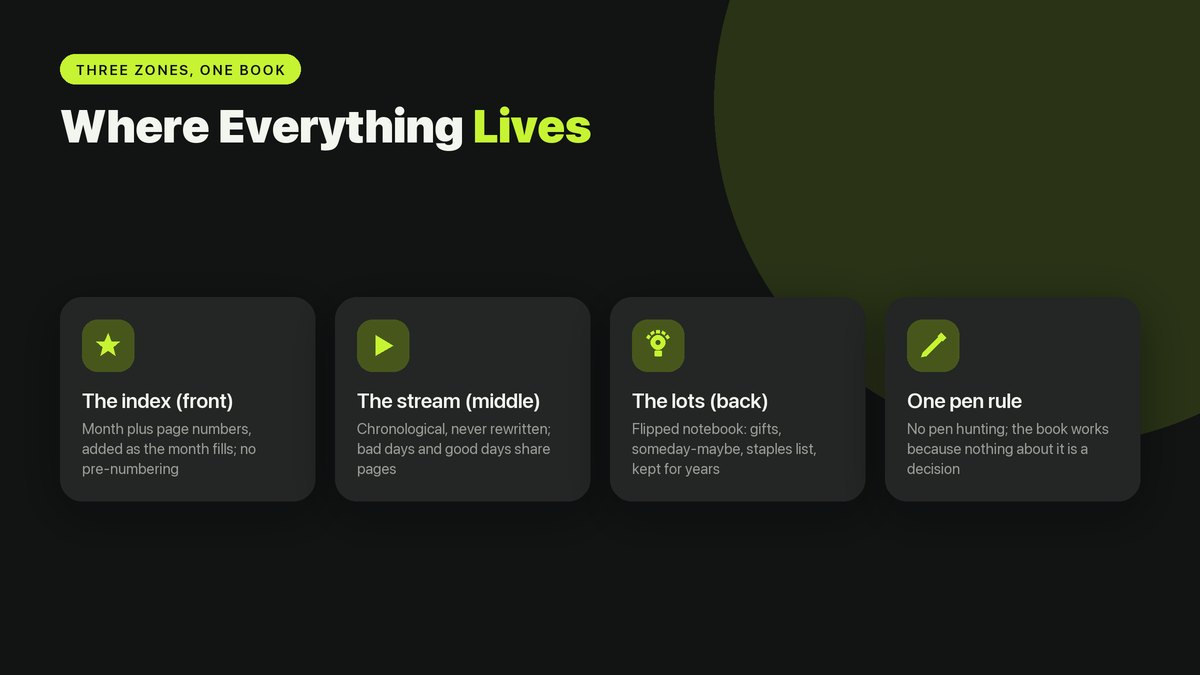
One more rule, and I mean this literally. One pen. Pick a pen you like, keep it clipped to the notebook or tucked in the elastic band, and never negotiate with yourself about writing implements at the moment of capture. Pen-hunting sounds trivial, but it’s a decision, and every decision between you and the page is a place the habit can leak out. Mine is a cheap gel pen with a satisfying click. Yours can be a pencil. It doesn’t matter, honestly.
The Daily Page, or Date It, Dump It, Done
Every day gets one page, and every page starts the same way, with today’s date at the top, written before anything else. That’s the entire ceremony. After the date, you dump whatever is currently loaded in your head. Not in sentences. Not in order. A Tuesday-morning dump might look something like the mess below.
- Call dentist — the six-month reminder email finally arrived
- Thu 7 PM — dinner with Priya, don’t forget the casserole dish
- idea — ask landlord about the hallway light before it gets worse
- olive oil, rice, more of those decent tortillas
- weird dream, something about a ferry, probably nothing
Two of those lines matter. The rest is brain lint, and brain lint is allowed. The dump’s real job is to get the open loops out of your head and onto paper, where they stop charging you rent. David Allen built an entire productivity method around this observation, and if the name Getting Things Done rings a bell, yes, this is the same capture instinct wearing a much smaller outfit.
Once the dump exists, you add two marks. A small dot goes in front of anything that’s an open task, and a circle goes in front of anything that’s an event with a time attached. Everything else stays as plain ink. Those two marks are the system’s entire grammar, and they do more work than they look like. The dot means “this needs a decision from me later.” The circle means “this will happen whether I decide anything or not.” When you finish a dotted task, you cross it out with one horizontal line, so you can still read what it said. There’s a small satisfaction in a crossed-out row that a deleted notification has never once reproduced.
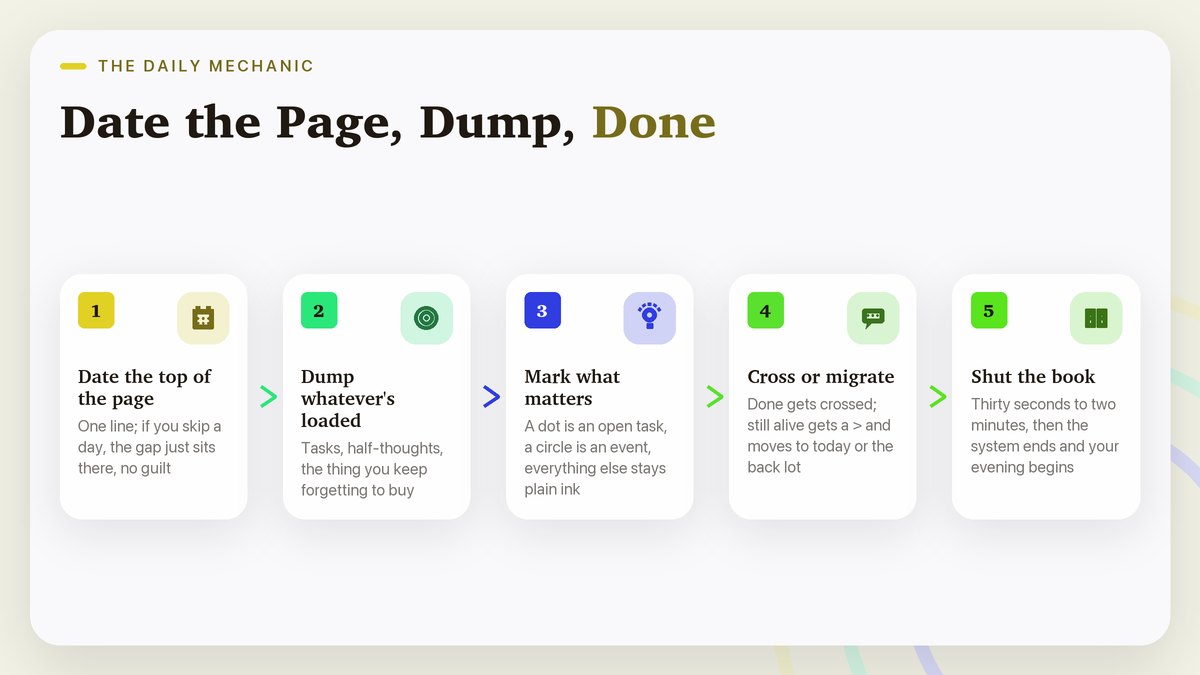
The last move of the day is migration. Anything with a dot that you didn’t finish gets a small > sign, and you rewrite it on today’s new page if it’s still alive, or on one of the back lists if it’s a someday thing. This is borrowed almost directly from the Bullet Journal method, whose rapid-logging and signifier ideas this system steals shamelessly and then shrinks to fit people who will never maintain an index of collections. The migration step matters more than it looks. Rewriting a task by hand is a tiny cost, and that cost is a filter. If you find yourself migrating “organize garage” for the sixth consecutive month, the annoyance of writing it again becomes the push you needed to either schedule it or admit you’re never doing it and let it go.
Three Zones, One Book
Flip your notebook open and it has three zones, divided the way books naturally divide. There’s no setup page, no legend on the inside cover that you’ll forget the meaning of by Tuesday. The zones are just habits of where you write.
The front is the index, and it stays nearly empty for a while. You’ll build it in the monthly reset, one month per line with the page numbers that month covered. The middle, which is most of the book, holds the stream. That’s the dated daily pages in the order they happened, never rearranged, never rewritten, a messy Tuesday and a triumphant Wednesday getting exactly the same treatment, which is to say, both just get to exist. The back of the book, approached from the last page and working inward, holds the parking lots. These are the lists with no expiration date. Gift ideas. Books people keep recommending. The grocery staples you rebuy. The things you’d fix in the house if you ever had a free weekend. When a back list fills its page, the next one starts on the page before it, and the old one stays forever.
Why one book instead of a task app, a notes app, and a diary? Partly it’s the physics. One object has one location, and “where did I write that” stops being a question with three possible answers. Mostly, though, it’s that the stream turns out to be worth more than the sum of its lists. Six months in, you can flip back through March in ninety seconds and see what you were actually doing, which projects were eating your evenings, and how many times “call dentist” appears before it finally got crossed out. That backward-looking view is the thing journaling promises and almost never delivers, and here it shows up as a side effect of a system you were running anyway.
The Monthly Reset Takes Fifteen Minutes
Set a phone reminder for the 1st, recurring, forever. That single alarm does half the maintenance.
Once a month, roughly, you sit down with the notebook for fifteen minutes. I say “on the first” because a fixed date beats a flexible intention every time, but the honest version of this system says to reset whenever you notice a new month has started, which is why the recurring reminder matters. Set it once. Noticing stops being required.
The reset has four moves. You flip back through the month that just ended, skimming for open dots and circled events. You add one line to the front index, the month plus the page numbers it spanned. Then you take every open task that survived the month and give it a verdict. Migrate it forward, or kill it. Killing is underrated. A task that’s survived three migrations without action is information about your actual priorities, and the right response to that information is usually a line through it and a small sense of relief. Finally, you write the new month’s first date line, and you’re done until next month.

That index line deserves more credit than it gets. It’s the difference between an archive and a pile, between being able to put your finger on any afternoon from the last two years and having to reread whole months to find one forgotten line. Two years of daily pages with no index is a haystack; two years with twelve lines at the front is a filing system you can search with your thumb. This is the one piece of the Bullet Journal tradition worth keeping even if you ignore everything else, and it’s maybe five minutes of the fifteen.
What to Write When There’s Nothing to Write
The daily dump works best on busy days. On quiet ones, the page can feel awkwardly empty, and this is the moment most journal systems lean on prompts like “what are you grateful for?” If that works for you, keep it, no judgment here. But for the prompt-averse, there are lower-pressure entries that still pay off later.
- The carryover check. Glance at yesterday’s open dots. Anything still alive gets rewritten today. Thirty seconds, and the page has already earned its keep.
- One concrete thing. Not “good day.” More like “the plumber came, it’s fixed, $140.” Future-you will be astonished how useful these flat little facts are.
- The nagging thing. Whatever has been circling your head for a week, write it down in plain words. Half the time the act of writing it resolves it; you can see, in ink, that it’s either trivial or actionable.
- Notes from something you consumed. A line from a podcast, a recipe tweak, a quote from the novel on your nightstand. It doesn’t need commentary.
If you want structure for the note-taking side of all this, Cornell’s Learning Strategies Center publishes some of the most sensible, hype-free note-taking guidance anywhere; their overview of study strategies is a good place to start, and the core habit they teach, paraphrasing ideas in your own words rather than transcribing, transfers directly to these pages. A page of your own rough shorthand beats a perfect transcription you never look at again.
Why Pen and Paper Still Win at This
It would be reasonable to ask why any of this needs to be analog. Your phone already has a notes app, after all, plus a reminders app, plus a calendar, and all three sync everywhere, which raises a fair question. The honest answer is that those tools are excellent at holding information and oddly bad at getting you to put it in.
There’s also a cognitive argument, and it’s stronger than the usual romantic hand-waving about stationery. In a widely cited 2014 study published in Psychological Science, Pam Mueller and Daniel Oppenheimer found that students who took notes by laptop tended to transcribe lectures nearly verbatim, while students writing by hand were forced to condense and rephrase, and the hand-writers consistently outperformed the typists on conceptual questions afterward. NPR’s write-up of the research lays out the setup and the results in plain terms. The notebook system’s daily dump works the same way. Ink is slow, and slowness is the filter.
The other advantage is the absence of everything else, because a paper page has no notifications on it, no badge counts, no adjacent app your thumb already knows how to open. When you pick up the notebook to write “buy rice,” rice is what gets written, because rice is all that’s there. That sounds like a small thing until you count how many times a day your phone errands end somewhere other than where they started.
Your notebook never interrupts you. That’s not nostalgia. That’s the whole feature.
Making It Stick Past the Honeymoon
When this system collapses, it does so in predictable ways. The most common failure is the decorative upgrade. Two weeks in, you watch a video of someone’s elaborate journal spreads and decide your plain pages need washi tape. Resist this. Decoration is a hobby, which is a fine hobby, but it’s a different hobby, and mixing it into a capture system raises the entry cost back to exactly the height where journals go to die. Your pages are allowed to be ugly. Mine are, routinely.
Failure number two is buying a second notebook for a second context, one for work and one for home. This reads as organization and functions as a leak. The whole point is that everything has one home. When work stuff is written in the same stream as grocery lists, neither pollutes the other, and you carry one object instead of two.
Then there’s the third failure, treating a missed week as a system failure. You will miss a week. Possibly several. The notebook does not care, and neither should you. Just open it, date today’s page, and the system resumes mid-stride with no catch-up entries required. This is the single biggest structural advantage it has over every diary format: there is no such thing as behind.
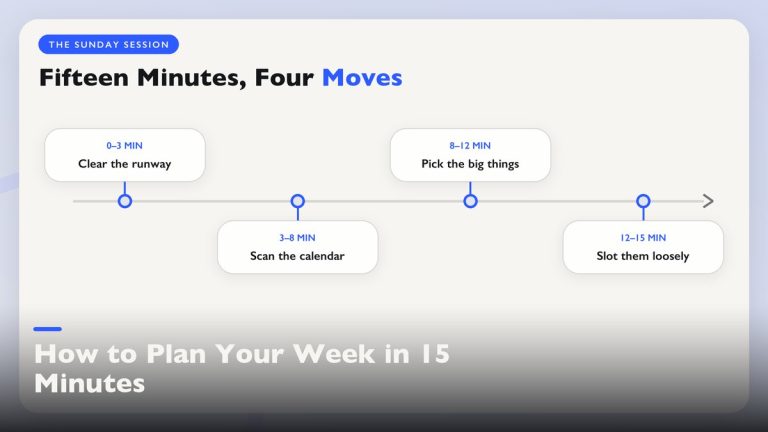
Finally, anchor it to something that already happens. The dump pairs naturally with the morning coffee, or the lunch you eat alone, or the first five minutes after the kids’ bedtime. If you’ve already got a weekly planning habit, this notebook slots in as its paper counterpart, the place where the week’s loose ends actually live day to day. And if you don’t have that habit yet, this is the lower-effort place to start: a week planned on paper tends to want a week planned, and the fifteen-minute Sunday session described in our guide to planning your week in 15 minutes is the natural next layer once the daily dump feels automatic.
Buy the boring notebook this week. Date the first page. Tomorrow morning, write the date and dump whatever’s loaded. That’s day one of a system you might still be running in five years, mostly because it never once asked you to be the kind of person who journals.
Related reads on this site: How to Plan Your Week in 15 Minutes · The 2-Minute Rule and Other Simple Productivity Tricks That Work · Digital Declutter: Organizing Your Phone in Under an Hour. External references: Bullet Journal · Getting Things Done · Cornell Learning Strategies Center · NPR on the Mueller & Oppenheimer note-taking study · Leuchtturm1917.