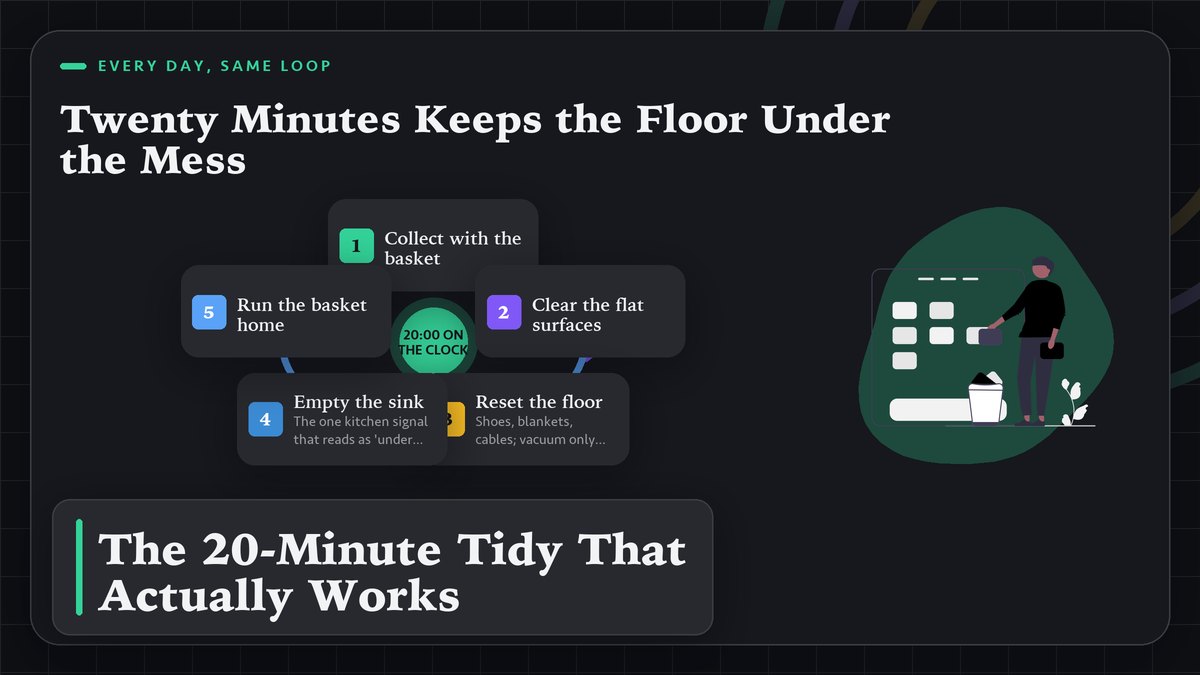
A daily reset you can finish on a weeknight, with a timer, one basket, and a hard rule against reorganizing anything. The house stays “company could knock” level all the time, and deep cleaning becomes a choice instead of an emergency.
I used to clean in marathons. You probably know the cycle. Saturday arrives, the apartment has drifted for two weeks, and suddenly it’s three in the afternoon and you’re on your knees scrubbing the grout with a toothbrush, furious at everyone including the toothbrush. The place looks amazing for about forty hours. By Wednesday the mail is on the counter again, there’s a sweater over a chair, and you’re back to ignoring it until the next blowup. A few years ago I stopped doing that, and the thing that replaced it is almost embarrassingly small. Twenty minutes a day, same time, timer running, basket in hand. That’s the whole system, honestly. The rest of this article is just the details that keep it from dying off the way every other cleaning system I’ve tried has died.
The twenty-minute tidy isn’t a deep clean, and it isn’t meant to be. It’s a reset, a hard floor under the mess, kept at the same level every single day so the house never slides far enough to need a rescue mission. If your place is currently in rescue-mission territory, you can still start this week; there’s a section below on what to do about the backlog first.
In this article
Why Twenty Minutes Beats Two Hours
There’s a psychological trick buried in the timer, and it’s the entire reason this works. Two hours of cleaning is a project, and projects get negotiated with. You’ll do it after lunch, then after the errands, then next weekend, and the pile grows the whole time. Twenty minutes is an appointment. You don’t negotiate with an appointment; you just show up, and then it’s over. I’ve never once talked myself out of a twenty-minute tidy. I’ve talked myself out of every marathon I ever planned.
The scope does something too. When you only have twenty minutes, you can’t try to clean the house, so you don’t start the way marathon cleaning starts, which is standing in the middle of the room, turning in a slow circle, wondering where to even begin. The timer makes the decision for you. You begin wherever the basket is, and you keep moving. No strategy session, no optimizing, no watching a video about cleaning systems instead of cleaning (I’ve done that one more than I’d like to admit).
And there’s some real research behind the “why bother” question. A much-cited UCLA study of families and their homes found that women who described their living spaces as cluttered had higher cortisol patterns across the day, the stress hormone failing to drop the way it normally would. I’m not going to pretend a twenty-minute tidy fixes your stress. But a counter that stays clear and a floor you can walk across do change how a room feels when you walk into it at 7 pm, and that part is not small.
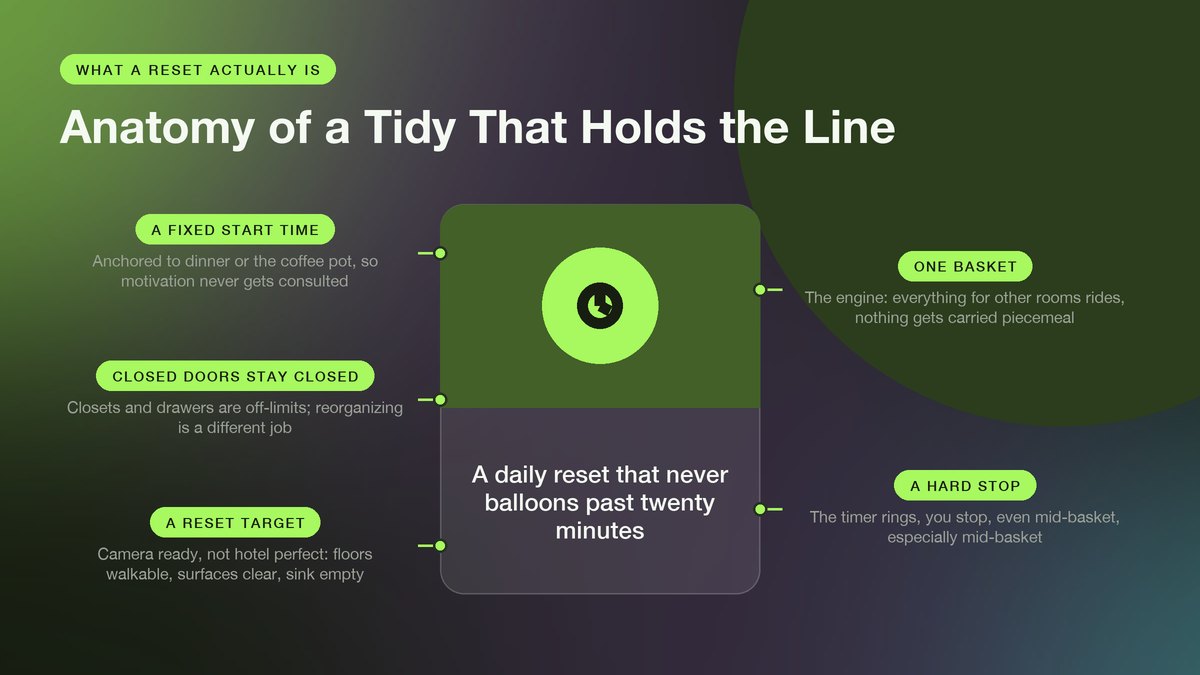
The goal of the daily tidy is “camera ready,” not “hotel perfect.” You’re removing the evidence of the week and leaving the house otherwise alone.
One more honest reason twenty minutes a day works is that it keeps the emotional temperature down. Marathon cleaning always carries a faint accusation with it, someone silently tallying who left what where. A short daily reset just doesn’t have time to build up that resentment. It’s maintenance, nobody resents brushing their teeth.
What You Need: The Five-Thing Kit
Part of why cleaning systems collapse is the preamble. You buy the caddy, the special brushes, the matching spray bottles, and by the time the kit is assembled you’ve spent an afternoon and $80 and the actual cleaning still hasn’t happened. This kit is five things, most of which you already own, and it lives in one spot so you never spend the first ten minutes hunting for supplies.
- The timer. Your phone works fine. The kitchen timer works better, mostly because it doesn’t have a screen full of other things on it. Twenty minutes, started the moment the basket comes off its hook.
- One basket or tote bag. This is the engine of the whole system. Anything that belongs in another room goes in the basket, not under your arm, and definitely not one item at a time. Carrying single items to other rooms is how twenty minutes turns into an hour of house wandering.
- Trash bags and a recycling bag. These hang on the same hook as the basket. Half of most messes is stuff that’s done being used: mail already read, packaging, the tissue box with three tissues left in it.
- Microfiber cloth plus one all-purpose cleaner. Not five products. The Bob Vila’s cleaning guides repeat the same advice you’ll hear from any experienced housekeeper, which is that one decent all-purpose cleaner covers most daily jobs and the cloth does more work than the spray does. If you’re buying a product anyway, the EPA’s Safer Choice label is the fastest way to check a cleaner’s ingredient list without a chemistry degree.
- One designated “landing spot” per room. This one is invisible but it matters. Every room gets one small tray, bowl, or corner where today’s odds and ends are allowed to live. The tidy resets the landing spot to empty. Without one, clutter just migrates from surface to surface like it’s touring.
That’s it. No caddy, no color-coded system, no label maker. Total cost if you own nothing: maybe twenty-five dollars, and most of that is the basket if you want a nice one.
Two small notes on the kit before we move on. First, microfiber cloths are one of the few cleaning products worth buying deliberately rather than improvising: a dry one lifts dust off shelves and screens without any spray at all, and a damp one handles most wipe-downs. Buy a ten-pack, keep half in the basket and half near the kitchen, and throw them in the wash with the towels. Second, resist upgrading the kit for at least a month. Fancy tools feel like progress but they’re usually procrastination in a nicer outfit, and a spray bottle you already own cleans exactly as well as the one with the ergonomic trigger.
The 20-Minute Sequence
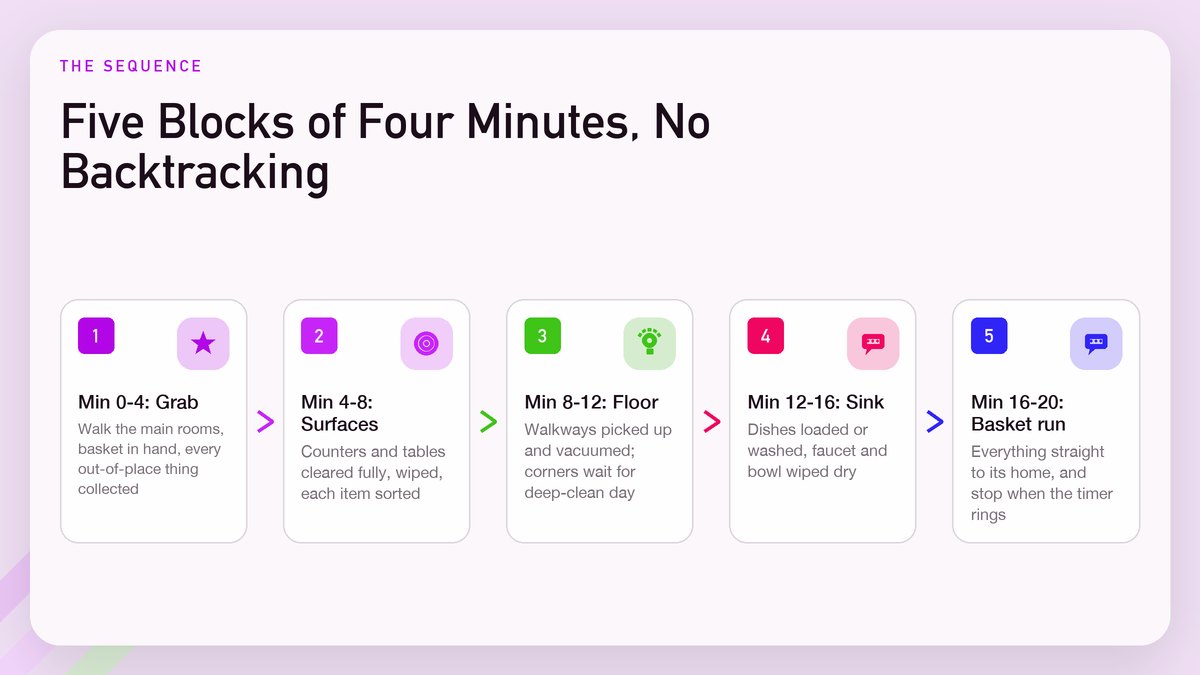
Run the order exactly as written for at least two weeks before changing anything. The sequence is built on one principle, which is that you handle each category of stuff once and you never backtrack. Backtracking is where the time goes to die.
The first four minutes are pure collection. Walk the main rooms with the basket and gather everything visibly out of place; don’t put anything away yet, don’t evaluate anything yet, you’re just building one mobile pile of strays with your hands moving the whole time. Pull the trash bags off the hook on your way past, too.
Next come the flat surfaces, minutes 4–8. Kitchen counters, coffee table, desk, the shelf by the door. Clear each one fully, wipe with the cloth, and sort whatever you removed into three outcomes, namely back where it lives, into the basket for another room, or into a bag because it’s trash. This is the block that changes how the whole apartment reads, by the way, because counters are the biggest visual real estate in most homes, and a cleared counter fools everyone, including you, into thinking the place is basically done.
The floor gets minutes 8–12. Everything on it that shouldn’t be there goes somewhere else; shoes to the mat, blankets folded over the couch arm, the charger cable coiled on the side table instead of stretched across the walkway. Then vacuum or sweep only the high-traffic lanes, meaning the path from the door to the kitchen and the path to the couch, and leave the corners for deep-clean day. Nobody walks in corners.
Then the dishes, minutes 12–16. A full sink is most of what makes a kitchen read as out of control, and an empty one does the opposite. Load or run the dishwasher. Hand-wash the three things that never fit, and wipe the faucet and sink bowl dry. A dry, empty sink looks clean even on a day when the rest of the kitchen is merely okay.
One thing worth deciding before your first run is what goes in your ears. Some people tidy to music with a strong beat, some to a podcast, some to nothing at all, and I’m not going to litigate it. What I will say is that the twenty minutes passes noticeably faster with audio running, and since the whole point is for this to feel like a small daily ritual rather than a chore you’re serving a sentence for, pick whatever soundtrack makes the basket feel lighter. The one thing to avoid is putting on a TV show “in the background,” because twenty minutes of television will beat twenty minutes of tidying every single time. The timer will ring while you’re still on the couch deciding it counts.
Minutes 16–20 belong to the basket run. Carry the basket room to room and empty it, putting each thing directly where it lives. This is the part where the “home for everything” pays rent. If every item has a spot, the basket empties in five minutes flat; if half your basket items have no home, you’ll feel the drag immediately, and that’s useful information for later.
When the timer rings, you stop. Even mid-basket. Especially mid-basket. Stopping on time is what keeps tomorrow’s tidy to twenty minutes, and it’s the single most-discipline-requiring part of the whole system for me. The half-finished basket by the door is tomorrow’s first five minutes, and it will still be there.
The One Rule That Protects the Whole System
I mean this literally, and I’ll put it plainly. During the twenty minutes you are not allowed to reorganize anything, no switching the pantry bins around, no finally sorting the junk drawer, no “while I’m here.” Those jobs are real and they deserve to happen, but they take a different kind of time, and smuggling them into the daily tidy is how twenty minutes becomes fifty and then becomes abandoned entirely.
The tidy is a reset. A reset returns things to their homes; reorganizing is changing where the homes are. If you notice mid-tidy that the umbrella stand by the door is obviously wrong and the closet is obviously right, write it on a sticky note and put it on the fridge, where Saturday can find it. It does not get to become a Tuesday-night detour.
This rule matters more than any other part of the article, so I’ll say it twice in different words. The twenty-minute tidy exists to hold a floor; improving the house is a separate job with its own scheduled time. When the two get mixed, both die.
Where Everything Goes: The Four-Way Sort
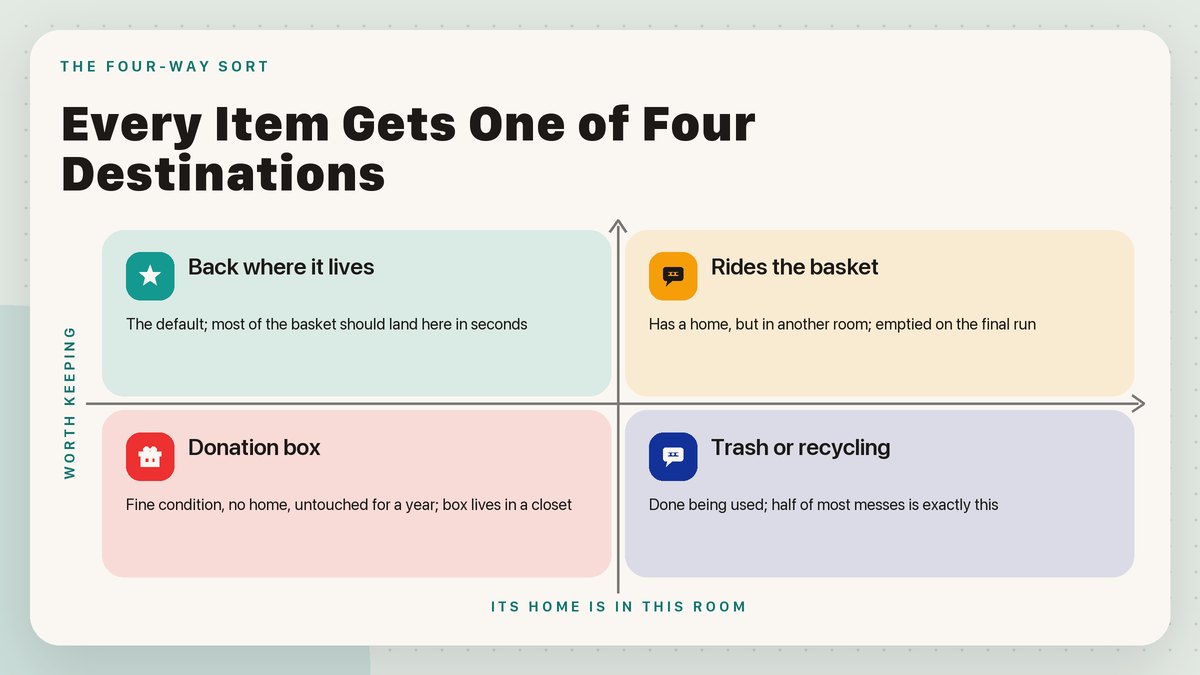
Every item you pick up during the tidy gets exactly one of four destinations, decided in about two seconds. The speed matters. Sorting slowly is really just decision fatigue wearing a costume, and most of the stuff in a basket doesn’t deserve a committee meeting.
The first destination is back where it lives, the default for anything with a working home. Mug to the shelf, charger to the drawer, book to the nightstand pile. Most of the basket should land here, and if it doesn’t, the problem sits upstream, in a house where too many things lack homes and the tidy keeps tripping over them.
Then there are the things whose homes happen to be in other rooms. They ride in the basket until the basket run, and the discipline is refusing to walk them over one at a time the moment you touch them. I know that feels efficient. It isn’t; it’s a trail of breadcrumbs that ends with you in the bedroom folding laundry that was never part of the plan.
Third, the easy calls. Food wrappers, dead pens, junk mail, the Amazon box you’ve been saving for no reason you could articulate under oath. If the trash bag fills, tie it off and take it straight to the bin, because a full bag waiting by the door is just clutter with extra steps.
The fourth destination is the awkward one, the thing that’s perfectly fine but has no home anywhere and hasn’t earned one. That goes to the donation pile, which deserves a permanent box in a closet or the garage instead of a growing mound of indecision on a chair. When the box is full, it goes to a Habitat for Humanity ReStore or a PickUp Please donation pickup, both of which take household goods in fine, usable condition. My test is simple. If I haven’t reached for it in a year and replacing it would cost under twenty dollars, the decision is already made.
The four-way sort has no fifth option. “I’ll deal with it later” is just destination four with extra guilt attached.
Making It Stick Past the First Two Weeks
Every cleaning habit fails the same way: not dramatically, just with one skipped evening, then a skipped week, then a quiet forgetting. The fix is to anchor the tidy to something that already happens every day, so it doesn’t need its own motivation supply. After dinner dishes works for most people. Right before the shower you’ll take anyway works for others. Mine rides on the coffee pot. The tidy starts when the morning’s grounds go in the compost, which means the apartment gets reset before I’ve fully woken up, which is either brilliant or a little unhinged, jury’s out.
The second anchor is the never-miss-twice rule. Missing one day is life; it happens to everyone, including me, probably once every two weeks or so. Missing two days in a row is the start of a new, worse habit, and that’s the line. If you missed yesterday, today’s tidy is non-negotiable, even if it’s a bad one done at half speed while grumbling. A grumpy fifteen-minute tidy still holds the floor.
If you share the house with other people, from roommates to a full family, there’s one more piece to it. The tidy is yours, and it stays yours, at least at first. This sounds counterintuitive, but trying to launch a group cleaning program and a personal daily habit at the same time is how both fail. Run your own twenty minutes for a few weeks, and something almost annoying happens: other people start joining in, because a visibly tidying person makes tidying look like the normal state of the house rather than a punishment being issued. You can formalize chores later if you want to. The daily reset needs no contract to work.
Third, keep the bar low on purpose. Some days you’ll glance around and think the place doesn’t really need it. Tidy anyway, quickly. The value of the daily tidy isn’t proportional to how messy the house was that day; it’s in the streak itself, the fact that the reset is a permanent feature of the house rather than a reaction to mess. Houses that get tidied daily stay tidy at roughly the same cost in the long run. Houses that get tidied only when needed are always either messy or mid-recovery, and both of those are more expensive than twenty minutes.
When Twenty Minutes Isn’t Enough
Some jobs are simply bigger than the system, and pretending otherwise is how the system breaks. Once a month or so, schedule a longer session, ninety minutes to two hours, for the things the tidy deliberately never touches: the inside of the microwave, baseboards, the fridge shelf with the sticky ring on it, washing the actual windows. Put it on the calendar like a dentist appointment, because it will never happen “when you feel like it.” Nobody has ever felt like baseboards.
| Job | Time | How often |
|---|---|---|
| Daily tidy (the reset) | 20 minutes | Every day, anchored to an existing habit |
| Micro-clean add-ons | +5 minutes | As needed: sink scrub, mirror wipe, toilet swish |
| Zone clean | 30–45 minutes | Weekly, rotating one room per weekend |
| Deep clean | 90–120 minutes | Monthly, scheduled in advance |
Guests are the other common exception, and the tidy handles them better than you’d expect. Run the normal twenty minutes, then add one “guest lens” pass. Stand at your front door and walk in slowly, noting the first three things you’d notice if this were someone else’s house. Almost always it’s the entry shoes, one cluttered surface, and a bathroom mirror. Ten extra minutes covers all three, and the visit goes fine, because guests register “clean, cared-for house” off about four visual signals and never look closer.
Two seasonal moments deserve a mention here too. When the seasons turn, add one fifteen-minute add-on to the tidy, rotating the closet, shaking out the entryway rug, clearing the porch of three months of drifted leaves. And if you’re about to move apartments or houses, this system becomes a gift you didn’t know you were buying. A house that gets a daily twenty-minute reset never develops the terrifying final-week purge, and you’ll pack in a calm, boring, mostly-finished house instead of a disaster site with a deadline.
And if life gets heavy, a week of skipped tidies is survivable. The floor you’re standing on is a habit, not a streak score. Restart the day you notice, no catching up owed, no guilt tax. The apartment forgives immediately, which is more than I can say for some people I know.
So tonight, when dinner’s done, set the timer for twenty minutes, grab the basket, and go. Tomorrow it’ll be easier, because the basket will be lighter and the counters will already be clear, and in about two weeks you’ll catch yourself, mid-tidy, realizing the house hasn’t needed a marathon in a month.
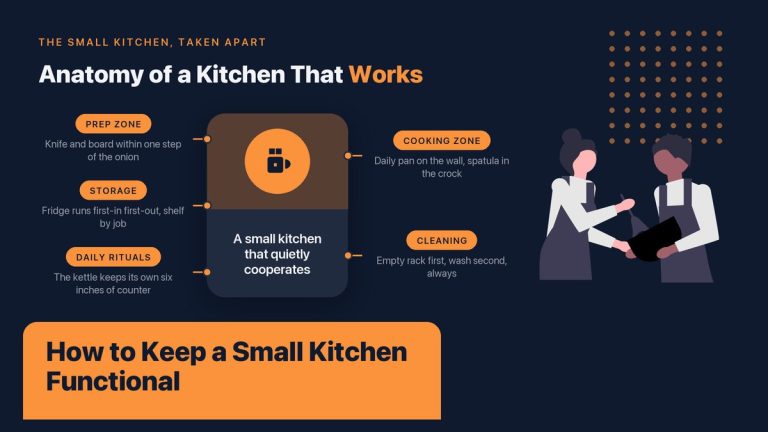
Related reads on this site: How to Stop Misplacing Things: A Home-for-Everything System (the upstream fix for basket items with no home), Small Space Organization Ideas, and How to Keep a Small Kitchen Functional (the nightly kitchen reset that pairs with this tidy).